


For AI engineers, system architects, devops engineers, and automation builders. Focus keyword density intentionally conservative. Claims backed by primary sources throughout.
TL;DR — Read this before anything else
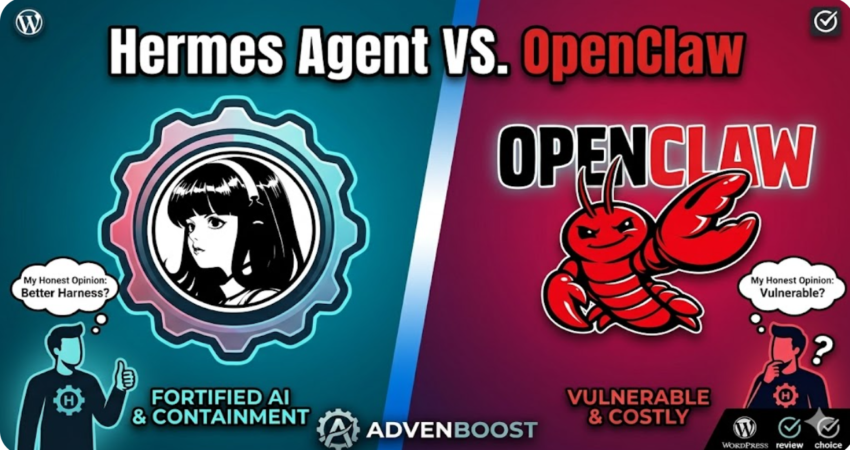
- Hermes Agent (Nous Research) is a self-improving agent runtime: a learning loop that compounds skills and memory across sessions. It is adaptive by design and trades predictability for growth over time.
- OpenClaw is a gateway-first orchestration control plane: a structured routing layer that sits between your messaging channels and any LLM. It trades adaptability for explicit controllability.
- Choosing the wrong system for your architecture isn’t a feature gap — it’s a category mismatch that generates operational debt for months.
- OpenClaw carries a documented, actively exploited security surface that must be treated as a first-class engineering concern before any production deployment.
- Hermes carries real token burn and memory desync risks at scale that compound over weeks of continuous use.
- Neither system is enterprise-ready out of the box. Both require hardening. Read the failure modes section before deploying either.
Why This Comparison Matters in Real Systems
The phrase “AI agent” now covers a spectrum so wide it is nearly meaningless. A pipeline that calls a single LLM and executes one tool call is described with the same vocabulary as a multi-agent orchestration layer managing parallel subagents, credential pools, and stateful memory across weeks of continuous operation.
The Hermes Agent vs OpenClaw comparison sits at the center of this confusion. Both are open-source. Both are self-hosted. Both connect LLMs to real-world systems. Yet their architectural philosophies are fundamentally different — and deploying one where you need the other will produce failures that surface slowly, expensively, and sometimes irreversibly. This article exists to prevent that.
Sources used throughout: Hermes Agent official architecture docs, OpenClaw gateway architecture docs, security research from The Hacker News, Microsoft Security Blog, Infosecurity Magazine, and production issue reports from the NousResearch GitHub repository.
Architectural Philosophy: Where the Systems Diverge
Before examining features, understand the foundational philosophy gap. These are not two implementations of the same idea. They represent different answers to the question: where should intelligence live in an agentic system?
Hermes Agent
- Agent runtime with built-in learning loop
- Self-curating skill system (SKILL.md)
- Three-layer persistent memory architecture
- 18+ provider support via runtime resolver
- Six terminal backends (local, Docker, SSH, Modal, Daytona, Singularity)
- Synchronous orchestration engine (AIAgent in run_agent.py)
- SQLite + FTS5 session archive
- MIT License — fully open
OpenClaw
- Gateway-first control plane (WebSocket, port 18789)
- Single source of truth for sessions, routing, channels
- Model-agnostic: Claude, GPT, Gemini, Ollama
- Static SOUL.md personality + knowledge layer
- Multi-agent orchestration: orchestrator spawns child agents
- Channel adapters: WhatsApp (Baileys), Telegram (grammY), Discord, Slack, Signal
- ClawHub skill marketplace
- Runs as systemd (Linux) or LaunchAgent (macOS)
Expert Insight — Architectural Philosophy
Hermes is built around the assumption that the agent itself should improve. Its learning loop is described in official docs as “a first-class architectural concern” — not a feature added on top of a static runtime, but the organizing principle of the whole system. OpenClaw is built around the opposite assumption: the orchestration layer should remain stable and predictable, with the model swappable underneath. This is why OpenClaw’s Gateway is intentionally separated from the LLM — the docs explicitly note it “never touches the model directly.” Neither philosophy is wrong. They answer different engineering questions.
According to the Hermes Agent architecture documentation, the synchronous orchestration engine handles provider selection, prompt construction, tool execution, retries, fallback, callbacks, compression, and persistence — all within a single coherent loop. OpenClaw’s Gateway architecture documentation describes a different separation: the Gateway processes routing and session management while the model handles reasoning, and these remain deliberately decoupled.
Runtime Behavior Under Load
Hermes Agent: How the Learning Loop Performs at Scale
Hermes Agent operates as a full agent runtime, not a chat wrapper. Its documented architecture includes three key subsystems that interact under load: the prompt assembly pipeline (prompt_builder.py), the context compression engine (context_compressor.py), and the session persistence layer (SQLite + FTS5).
Under extended continuous operation, the context compressor activates when conversation length exceeds thresholds, summarizing middle turns to prevent context window overflow. This is a documented, intentional mechanism — but it introduces a tradeoff: compressed context loses granularity, and the agent’s decisions in later turns can drift from what was agreed upon in earlier, now-compressed exchanges.
A critical production issue filed against the NousResearch GitHub repository (Issue #5563, April 2026) documents a 12-hour intensive session where approximately 2.6 million tokens — roughly 69% of total consumption — were lost to context replay overhead. The same report documents SQLite state.db corruption under concurrent write load from CLI, gateway, and subagent processes, resulting in permanent loss of 18 sessions from the database index (though raw JSONL files on disk remained intact).
⚠️ Common Pitfall — Hermes Agent
Memory is loaded as a frozen snapshot at session start for LLM prefix cache stability. According to the Hermes memory documentation, updates written during a session are persisted to disk immediately but won’t appear in the system prompt until the next session begins. Engineers expecting live memory update behavior will encounter silent divergence between what the agent knows and what it says it knows.
OpenClaw: How the Gateway Behaves Under Concurrent Load
OpenClaw’s Gateway processes messages in a session one at a time via a command queue. According to FreeCodeCamp’s architectural analysis, simultaneous messages from the same session are queued — not rejected — to prevent state corruption and conflicting tool outputs. This is a sound design choice for a gateway, but it introduces latency spikes when multiple high-priority actions arrive simultaneously.
In multi-agent mode, OpenClaw spawns child agents that run independently and report back to the orchestrator. According to the OpenClaw multi-agent documentation, each subagent “runs its own Agentic Loop independently.” The failure condition not documented clearly in most guides: if a child agent dies silently mid-task, the orchestrator receives no completion signal and the task hangs. Based on observable patterns in distributed agent architectures, this timeout-without-signal failure mode is a known risk class in systems that lack heartbeat protocols between orchestrator and subagents.
💡 Pro Tip — OpenClaw Multi-Agent Deployments
The OpenClaw multi-agent guide recommends exhausting single-agent capabilities before adding orchestration complexity. Most production failures in multi-agent OpenClaw deployments trace back to over-engineering: elaborate 14-agent pipelines built for tasks a single well-configured agent handles reliably.
Real Failure Modes (Not in the Marketing Docs)
Hermes Agent: Failure Taxonomy
Memory desync across sessions. The frozen-snapshot memory design means any information written during a session is invisible to the agent’s current reasoning until the next session begins. In multi-day projects, this creates a documented phenomenon where the agent confidently operates on outdated context. The only mitigation is explicit session restarts and manual context injection.
SQLite FTS5 B-tree corruption. Under concurrent write access from CLI, gateway, and parallel subagent processes, the state.db database can corrupt its B-tree index. The GitHub issue #5563 documents PRAGMA integrity_check failures resulting in non-functional session_search — the agent’s only mechanism for cross-session recall. Without session_search, Hermes loses all episodic memory retrieval capability. Recovery requires manual dump, filter, and FTS rebuild, with permanent loss of any sessions whose JSON logs are missing.
Context window hallucination after extended sessions. After 700K+ tokens of continuous context in a single session, the documented production case shows the agent confusing tool description language (“cloud sandboxes may be cleaned up”) with its actual execution environment, falsely concluding it was running in a remote container when operating locally. This is an emergent behavior of long-context reasoning degradation — not a bug in the traditional sense, but a predictable failure mode at scale.
Skill loading token overhead. Community analysis cited in Hermes Agent memory documentation identifies the skills catalog as one of the largest system prompt token consumers — approximately 2.2K tokens for a typical skills list. At 40+ custom skills, this overhead becomes operationally significant.
OpenClaw: Failure Taxonomy
ClawHub supply chain compromise. This is not a theoretical risk. According to research documented by The Hacker News, 335 malicious skills were identified on ClawHub using fake prerequisites to install the Atomic Stealer malware. The root cause: ClawHub is open by default, requiring only a GitHub account at least one week old to publish. Snyk‘s ToxicSkills audit found that 36% of all ClawHub skills contain detectable prompt injection patterns, running with the same privileges as the agent itself.
Indirect prompt injection via ingested content. OpenClaw’s architecture — reading emails, web pages, Slack messages, documents — creates an attack surface where malicious instructions embedded in processed content can redirect agent behavior. A documented log poisoning vulnerability (addressed in v2026.2.13) allowed attackers to write to log files via WebSocket requests to publicly accessible instances; since the agent reads its own logs for troubleshooting, injected text could influence operational decisions.
Unauthenticated public exposure. A Shodan scan conducted in January 2026 and cited by Kaspersky’s security blog discovered nearly a thousand publicly accessible OpenClaw installations running with no authentication. A later Censys fingerprinting analysis identified 63,070 live instances. The default management port (18789) exposed without token auth provides full system access to anyone who can reach it.
🚨 Critical Risk — OpenClaw Default Configuration
The Microsoft Defender Security Research Team stated explicitly: “Because of these characteristics, OpenClaw should be treated as untrusted code execution with persistent credentials. It is not appropriate to run on a standard personal or enterprise workstation.” This is not a fringe security opinion — it reflects OpenClaw’s architectural reality of broad system permissions combined with dynamic code execution from external sources.
Real Cost Analysis: Hidden vs Perceived
Most cost comparisons for agent systems focus on per-API-call pricing. This is the wrong metric. The real cost drivers in both systems are structural.
Hermes Agent: Token Burn Anatomy
Hermes builds its system prompt from stable sources to enable prefix caching. According to the architecture documentation, prompt_caching.py applies Anthropic cache breakpoints for prefix caching. Three events break this cache: switching models mid-session, changing memory files, or modifying context files. Each cache break in a long session restarts the billable input token count from zero for that session’s prefix.
The documented production incident (Issue #5563) quantified the real cost: 69% of tokens consumed in a 12-hour session went to context replay overhead — not to productive work. At Claude Opus pricing, this translates to substantial unexpected spend in high-utilization scenarios. The context compressor mitigates but doesn’t eliminate this: compression itself requires an auxiliary model call, adding latency and cost.
The memory system documentation shows a hard memory cap of 2,200 characters for MEMORY.md. This constraint exists deliberately to keep system prompts bounded for caching. But it forces the agent to make discard decisions — nuanced specifics get compressed away under memory pressure, creating silent context drift that is very difficult to diagnose from the outside.
OpenClaw: Cost Behavior at Scale
OpenClaw’s cost structure is different. The OneClaw platform analysis documents that ClawRouters integration can reduce API costs by 40–60% through intelligent model routing — using cheaper models for lower-complexity routing decisions and premium models only for reasoning-heavy tasks. This is a real cost optimization when configured correctly.
The hidden cost in OpenClaw is operational: security incident remediation. A single misconfigured public-facing instance represents credential exfiltration risk across every service the agent has API access to. The CrowdStrike security analysis notes this creates a “significantly larger blast radius” than traditional software vulnerabilities because the agent has persistent, credentialed access to multiple integrated systems simultaneously.
Expert Insight — Hidden vs Perceived Cost
Engineers evaluating these systems often calculate “token cost per task” as the primary expense. The real cost hierarchy is different: (1) engineering time spent debugging failure modes that aren’t documented, (2) security incident response when defaults are left unmodified, (3) operational overhead of connector maintenance as external APIs change, (4) token burn from architectural inefficiencies. Token cost per task ranks fourth. Price the total operational cost, not the API invoice.
Security Model and Exposure Surface
Hermes Agent Security Posture
Hermes Agent includes documented memory injection defenses. According to the Hermes memory documentation, memory entries are scanned for injection and exfiltration patterns before being accepted, since they are injected into the system prompt. Content matching threat patterns — prompt injection, credential exfiltration, SSH backdoors, invisible Unicode characters — is blocked at the memory write layer.
Hermes supports air-gapped deployment with local Ollama inference and a local Hermes model (GGUF variants). According to the Petronella Technology Group analysis, this makes Hermes Agent viable for CMMC, HIPAA, and CJIS compliance contexts, where data-out prohibitions apply. OpenClaw has no documented equivalent air-gap configuration path.
OpenClaw Security Posture
OpenClaw’s security record in 2026 is extensive and documented from multiple authoritative sources. The Infosecurity Magazine documented six vulnerabilities patched by Endor Labs, including three high-severity CVEs with public exploit code: CVE-2026-26322 (SSRF in Gateway tool, CVSS 7.6), CVE-2026-26319 (missing webhook authentication, CVSS 7.5), and CVE-2026-26329 (path traversal in browser upload). A comprehensive security audit identified CVE-2026-32922 (CVSS 9.9) — a privilege escalation flaw enabling full system access through token scope misuse.
The CNCERT advisory (China’s National Computer Network Emergency Response Technical Team) identified OpenClaw’s “inherently weak default security configurations” as the primary risk vector. The advisory specifically calls out prompt injection from web content, malicious ClawHub skills, and credential exfiltration from the ~/.clawdbot/.env and ~/.openclaw/credentials/ plaintext files.
OpenClaw has since partnered with VirusTotal to scan ClawHub submissions. As of March 2026, VirusTotal has analyzed over 3,000 skills. This is a meaningful improvement. However, prompt injection payloads embedded in dynamically loaded content can still evade static analysis, and the underlying architectural issue — broad system permissions with dynamic external code execution — remains structurally unchanged.
Governance, Auditability, and Enterprise Readiness
OpenClaw Mission Control
The OpenClaw Mission Control project provides a centralized governance layer: unified visibility, approval controls, and gateway-aware orchestration. It supports approval-driven governance — routing sensitive actions through explicit approval flows — and provides audit logs of agent decisions and gateway management for distributed environments. This is the closest either system comes to enterprise governance capability, and it is a third-party community project, not a first-party shipping feature.
Hermes Agent Governance
Hermes Agent does not have a documented enterprise governance layer. Audit visibility is provided through SQLite session logs, JSONL transcript files, and memory file inspection. For compliance environments requiring change approval flows, structured traceability, or multi-user agent lifecycle management, Hermes requires custom tooling to be built on top of its existing persistence layer.
💡 Pro Tip — Enterprise Deployment
For multi-user environments, neither system ships with role-based access control, credential isolation per user, or shared audit dashboards out of the box. Both require hardening before enterprise deployment. The FreeCodeCamp OpenClaw security guide and the Petronella Technology enterprise analysis both cover hardening paths in detail. Treat these as required reading before any production deployment.
Comparison Table
| Dimension | Hermes Agent | OpenClaw |
|---|---|---|
| Architecture type | Agent runtime + learning loop | Gateway-first orchestration control plane |
| Primary design goal | Adaptive self-improvement over time | Stable, controllable task routing |
| Autonomy level | High — agent makes memory/skill decisions | Configurable — orchestrator-defined sub-task scope |
| Memory architecture | 3-layer: MEMORY.md / session SQLite / pluggable providers | Session-scoped + SOUL.md static context |
| Multi-agent support | Via delegate_task subagents (parallel) | Native orchestrator/child-agent pattern |
| Provider support | 18+ providers + any OpenAI-compatible endpoint | GPT, Claude, Gemini, DeepSeek, Ollama |
| Skill/extension system | SKILL.md files + agentskills.io hub (MIT-compatible) | ClawHub marketplace (open submission) |
| Cost behavior at scale | Context replay overhead (up to 69% token waste documented) | 40–60% savings possible via ClawRouters; high incident cost risk |
| Security posture (default) | Memory injection scanning; no hardened default config | Weak defaults; 60+ documented CVEs; CNCERT advisory issued |
| Air-gap deployment | Supported (Ollama + GGUF local inference) | No documented path |
| Enterprise governance | Custom tooling required | Third-party Mission Control project available |
| Auditability | SQLite + JSONL session logs | Gateway logs + Mission Control approval flows |
| Predictability | Lower — learning loop introduces behavioral drift | Higher — static gateway with explicit configuration |
| Migration friction | MEMORY.md + SKILL.md are portable flat files | SOUL.md portable; session state migration requires custom scripts |
| License | MIT | Open-source |
| Compliance-ready | Air-gap path viable for CMMC/HIPAA with configuration | Not recommended for regulated environments without full hardening |
Real-World Deployment Scenarios
Scenario 01 — Startup: Solo developer personal automation pipeline
You need an agent that runs on a single machine, handles messaging integrations, writes and improves its own workflows, and compounds knowledge about your codebase and preferences over weeks. You want to minimize setup friction and maximize per-session capability growth.
Verdict: Hermes Agent
The learning loop and pluggable memory providers are directly suited to this use case. Documented air-gap support matters if you’re working with proprietary code you can’t send to external APIs.
Scenario 02 — Enterprise: Team-wide AI assistant with compliance requirements
You need multiple users to share agent infrastructure, with explicit approval flows for high-consequence actions, audit logs for compliance review, and a security posture that can survive a SOC 2 audit. You need predictable behavior and explicit configuration over adaptive autonomy.
Verdict: OpenClaw (hardened)
OpenClaw’s Mission Control layer provides the governance primitives. Hardening is mandatory and non-trivial. Treat the Microsoft Security advisory as a required configuration checklist. Deploy in an isolated container environment only.
Scenario 03 — Scaled automation pipeline: 200+ concurrent tasks, parallel subagents
You’re building a pipeline that spawns parallel subagents for batch processing — researching companies, processing CSV rows, delegating writing and validation in parallel. You need orchestration reliability, not agent intelligence growth.
Verdict: OpenClaw
OpenClaw’s native orchestrator/child-agent pattern is architecturally suited to this. Hermes’s delegate_task subagent support exists but is less mature for high-concurrency batch scenarios. Monitor for silent subagent death; implement timeout-based health checks externally.
Scenario 04 — Failure recovery: Database corruption mid-operation
Your Hermes Agent instance’s state.db has been corrupted under concurrent write load. Session search is non-functional. The agent has lost cross-session recall for a two-week development project.
Verdict: Recovery path exists; requires manual intervention
Run sqlite3 state.db "PRAGMA integrity_check" to assess corruption extent. Use .dump to extract recoverable data. Filter corrupted rows. Rebuild FTS5 index. Raw JSONL session files on disk are intact and serve as the recovery source. Prevention: enable external memory provider (Holographic or Hindsight) to redundant-persist session context outside the single SQLite file.
Predictability vs Autonomy: The Core Engineering Tradeoff
This is the tradeoff that most comparison articles skip. It matters more than feature counts.
Hermes is adaptive but less predictable. The agent makes independent decisions about what to remember, when to create skills, and how to compress context. Over weeks of use, its behavior diverges from a static baseline in ways that are difficult to fully audit. A skill written by the agent three weeks ago might influence current behavior in ways that aren’t surfaced to the operator. This is the cost of learning.
OpenClaw is structured but more controllable. Its behavior is determined by explicit configuration files — SOUL.md, agent definitions, channel bindings, permission sets. Changing behavior requires changing configuration. The operator always knows where the behavior specification lives. The cost is that it doesn’t improve without operator intervention.
Expert Insight — Autonomy Tradeoff
The autonomy-predictability axis is not a quality axis. High autonomy is correct for personal assistants, research agents, and single-operator workflows where the operator both benefits from and can tolerate behavioral variation. High predictability is correct for team environments, automated pipelines, and any context where behavior must be auditable and consistent across runs. Choosing Hermes for a pipeline that needs reproducible outputs, or choosing OpenClaw for a use case that requires learning and adaptation, is an architectural error — not a configuration problem.
Mistakes to Avoid When Selecting Either System
Hype-based selection OpenClaw crossed 100,000 GitHub stars in under two months. Hermes Agent achieved rapid adoption driven by Nous Research’s model reputation. Neither metric measures production reliability. Evaluate architecture fit for your specific autonomy-predictability requirements, not social proof.
Ignoring cost scaling before deployment Both systems have non-linear cost behavior at scale. Hermes’s context replay overhead can consume the majority of token budget in long sessions. OpenClaw’s security incident costs (credential rotation, incident response, potential data breach remediation) dwarf API invoice costs. Model these costs against your actual usage patterns before committing.
Treating default configurations as production-ready Neither system is production-safe at defaults. OpenClaw’s management port 18789 exposed without authentication gives full system access to any reachable network host. Hermes’s default ~/.hermes/ directory stores API keys and session data with standard filesystem permissions. Both require explicit hardening. Read the official security documentation for both systems before any external-network deployment.
Misconfiguring autonomy levels Giving an OpenClaw agent broad tool permissions without defining explicit approval gates is not “full autonomy” — it’s undefined behavior with credentials attached. Giving a Hermes agent a very long nudge_interval in short sessions means memory is never written and the learning loop never fires. Both misconfiguration types produce systems that appear to work while silently failing to do what the operator expects.
Migration Friction and Long-Term Lock-in
Hermes Agent’s portability story is relatively strong. MEMORY.md and USER.md are plain Markdown files. SKILL.md files are portable and compatible with agentskills.io. Session archives in JSONL format are human-readable. Migrating a Hermes Agent instance means copying a directory structure.
OpenClaw’s SOUL.md personality files and AGENTS.md configuration are similarly portable flat files. However, session state and conversation history migration between instances requires custom scripting against the session persistence layer. ClawHub skills are installable from the registry but community availability depends on the registry remaining operational and the specific skill remaining published.
The deepest lock-in risk in both systems is implicit behavioral dependencies: skills or memory entries that encode assumptions about the specific model, provider, or tool configuration in use. Switching model providers mid-deployment in Hermes breaks prefix cache and can introduce subtle behavioral changes across skills that were tuned on the previous model’s output characteristics. OpenClaw’s model-agnostic design mitigates this risk structurally — the Gateway is explicitly separated from the model layer.
Frequently Asked Questions
Which system handles multi-agent orchestration more reliably at scale?
OpenClaw’s native orchestrator/child-agent architecture is better suited to high-concurrency parallel workloads. Its documented pattern — orchestrator decomposes goals, child agents run independently, orchestrator synthesizes — maps well to batch processing pipelines. Hermes’s delegate_task subagent support exists but the system’s core design is single-agent with session parallelism, not native multi-agent orchestration. For 50+ parallel subagent scenarios, OpenClaw is the more architecturally appropriate choice, provided security hardening is applied first.
Can Hermes Agent run fully air-gapped for regulated environments?
Yes, with configuration. According to the Petronella Technology Group analysis, Hermes Agent can run fully air-gapped using Ollama as a local inference backend with Hermes 4.3 GGUF variants. The key dependencies that must be resolved locally: model inference endpoint, memory providers (use Holographic for zero external dependencies), and the skills hub (use local SKILL.md files instead of remote registry pulls). This makes Hermes viable for CMMC, HIPAA, and CJIS compliance contexts. OpenClaw has no documented equivalent configuration path.
Is OpenClaw safe for enterprise deployment?
Not in its default configuration. The Microsoft Defender Security Research Team explicitly states OpenClaw should not run on standard enterprise workstations. An enterprise deployment requires: isolated container environment, port 18789 blocked from public networks, token authentication enforced, ClawHub skill installation treated as code review events, and credential isolation per agent instance. With these controls applied, OpenClaw’s Mission Control governance layer provides the audit and approval primitives needed for regulated-context deployment. Without them, the system’s broad system permissions and dynamic code execution create an unacceptable blast radius.
How does the Hermes Agent learning loop affect behavior over time?
The learning loop — skill creation from experience, memory consolidation, self-evaluation during nudge intervals — produces behavioral drift relative to a static baseline. Over weeks of continuous use, an agent’s skill set and memory state diverge from initial configuration in ways that are beneficial (accumulated project knowledge, refined procedures) but also difficult to fully audit. The agent makes independent judgment calls about what is worth remembering. This is the intended behavior. For operators who need reproducible, auditable behavior across runs, this adaptive characteristic is a liability, not a feature. For single-operator personal automation, it is the primary value proposition.
What is the real cost difference between the two systems at scale?
The cost comparison is asymmetric in nature. Hermes Agent’s primary cost risk is token burn from context replay overhead — a documented production case saw 69% of total token consumption go to context replay in a 12-hour session. OpenClaw’s primary cost risk is operational security overhead: incident response, credential rotation, and engineering time spent auditing ClawHub skills. OpenClaw’s ClawRouters routing can reduce API costs by 40–60% in well-configured deployments. Neither system’s marketing materials quantify these real cost drivers accurately. Model total operational cost — not API invoices — before deployment decisions.
Final Decision Framework
The selection between these systems reduces to three questions:
Do you need the system to learn and improve autonomously? If yes — if the value of the system grows with use and you can tolerate behavioral variation — Hermes Agent’s learning loop is the right architectural choice. If no — if you need consistent, reproducible, operator-specified behavior — OpenClaw’s gateway architecture is more appropriate.
What is your security tolerance? If you’re operating in a regulated environment, handling sensitive credentials, or deploying on shared infrastructure, OpenClaw requires full hardening before any production use. Follow the Microsoft Defender advisory as a baseline. Hermes Agent requires hardening too — particularly around API key storage and session database permissions — but has a smaller documented attack surface as of April 2026.
Is this single-operator or multi-operator? Neither system ships with enterprise-grade multi-user controls. OpenClaw’s Mission Control project provides the closest available governance layer. Hermes requires custom tooling for multi-operator environments. Factor this engineering cost into your evaluation.
Both systems are actively developed, open-source, and backed by engaged communities. The right choice is the one that matches the architectural requirements of your specific use case — not the one with the most GitHub stars, the largest model, or the most impressive demo.
Primary Sources
- Hermes Agent Architecture Documentation — Nous Research (official)
- Hermes Agent Memory System Documentation — Nous Research (official)
- Hermes Agent Memory Providers Documentation — Nous Research (official)
- OpenClaw Gateway Architecture Documentation (official)
- OpenClaw Multi-Agent Orchestration Documentation (official)
- Hermes Agent GitHub Issue #5563 — Memory persistence and token waste field report (NousResearch)
- OpenClaw AI Agent Flaws Could Enable Prompt Injection and Data Exfiltration — The Hacker News (2026)
- Researchers Find 341 Malicious ClawHub Skills — The Hacker News (2026)
- ClawJacked Flaw: Log Poisoning and WebSocket Hijack — The Hacker News (2026)
- Running OpenClaw Safely — Microsoft Defender Security Research Team (2026)
- Researchers Find Six New OpenClaw Vulnerabilities — Infosecurity Magazine (2026)
- New OpenClaw AI Agent Found Unsafe for Use — Kaspersky Blog (2026)
- What Security Teams Need to Know About OpenClaw — CrowdStrike (2026)
- OpenClaw Security Issues Include Data Leakage and Prompt Injection — Giskard (2026)
- How to Build and Secure a Personal AI Agent with OpenClaw — FreeCodeCamp (2026)
- Hermes Agent 2026 Guide — Petronella Technology Group (2026)
- OpenClaw Mission Control — GitHub
- OpenClaw Security Risks: Skills, Exposure and Exploits — CyberDesserts (2026)
Related Articles
- OpenClaw vs Nanobot: What Most People Choose Wrong
- NanoClaw vs OpenClaw(2026): Which One Should You Choose?
- NemoClaw vs. OpenClaw: The Truth No One Tells You (2026)
- ZeroClaw vs. OpenClaw: Is the 99% Memory Reduction Actually Real?
- OpenClaw System Requirements: 5 Best Mini PCs for Reliable Agent Hosting in 2026
- OpenClaw on a $100 Budget — Complete Home Lab Hardware List (2026)
- Best Computer for OpenClaw: Top 6 PCs That Run It Smoothly
- OpenClaw Hardware: Best 7 Options to Host Your Agent
- Openclaw Docker: EASY SETUP GUIDE