


TL;DR
| What it is | An AI-powered creation studio that turns saved sources into drafted content inside a unified Board workspace |
| Biggest strength | The full research-to-draft pipeline lives in one place — collect, synthesize, and write without switching apps |
| Biggest weakness | Early-stage product with sparse documentation, no confirmed data export path, and performance lag on large boards |
| Who it’s for | Content creators, researchers, students, and founders who produce regularly and lose time in the gap between research and writing |
| Worth trying? | Yes — the free plan is genuinely functional and requires no credit card. Start there and evaluate before upgrading. |
Introduction
Most professionals don’t have a research problem. They have a conversion problem.
They save articles, watch YouTube videos, download PDFs — and then stare at a blank document with no idea how to turn that pile of material into something useful.
YouMind AI was built specifically for that gap. It’s an AI creation studio that connects the moment you save a source to the moment you publish a finished piece, without asking you to switch between five different tools along the way.
This guide covers everything you need to decide whether YouMind fits your workflow: what it actually does, where it performs, where it breaks down, and what the marketing leaves out.
What Is YouMind AI?
YouMind is a personalized AI learning and creation studio designed to turn what you read, watch, and listen to into publishable work — fast, structured, and in your own voice.
The company describes it as an ICE (Integrated Creation Environment) — a term coined by YouMind’s founder Yubo, a former Alibaba and ByteDance executive. The idea is that creative work deserves a unified environment the way software development has an IDE.
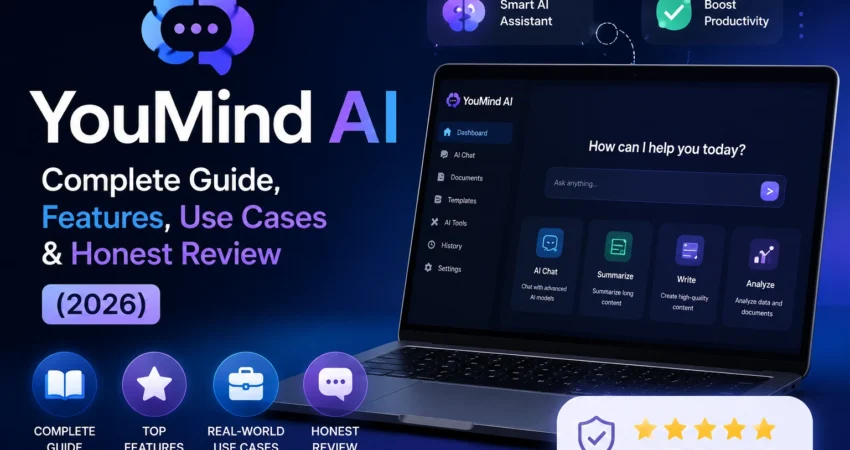
In practice, YouMind operates around a central concept called Boards. The core idea is that most content creators and researchers spend too long managing scattered inputs before they ever start writing. YouMind puts the collection, organization, AI research, drafting, and publishing into a single environment called a Board. You never have to leave the project to work on it.
Expert Insight: YouMind is not a note-taking app with an AI chatbot bolted on. The architecture is fundamentally different. The AI maintains context across all materials in a Board simultaneously, not just the document currently open. That distinction matters enormously for research-heavy workflows where the value comes from synthesis across sources, not summarization of individual ones.
The product has been actively developed through 2025 and early 2026. The most recent major release, YouMind 0.8, added a Skills library, Slides creation, and Smart Video (which turns finished slides into a narrated video in one click). The company maintains a strict privacy policy: your uploads and queries are not used to train AI models.
How YouMind AI Works
Understanding YouMind means understanding its core loop. This is not a storage system. It’s a pipeline.
| Stage | What Happens | Tool Used |
|---|---|---|
| 1. Collect | Save articles, PDFs, YouTube videos, podcasts, X posts | Browser extension, iOS app, URL paste |
| 2. Organize | Sources land in a Board with auto-generated summaries and mind maps | Board workspace |
| 3. Understand | AI synthesizes across all sources; you ask questions, highlight, annotate | AI Chat (Ask Mode / Agent Mode) |
| 4. Connect | AI identifies patterns and contradictions across your saved sources | Agent Mode |
| 5. Generate Insights | AI produces outlines, key themes, structured summaries | Skills / AI Writer |
| 6. Create Output | Draft articles, slides, audio episodes, or social posts from the research | AI Writer, Slides, Audio Pod |
YouMind offers a dual-mode AI experience. Ask Mode is for clean, instant answers and quick exploration. Agent Mode is for deeper, multi-step work — reading, summarizing, outlining, writing, and iterating with you across an entire project.
The workflow is linear in principle but nonlinear in practice. You can jump from collecting to drafting and back. The Board holds state throughout, so you don’t lose context between sessions.
Key Features of YouMind AI
Boards
The central organizing unit. Each Board is a project workspace containing all your saved sources, AI summaries, notes, highlights, and drafts. When you create a new Board, YouMind uses AI to search for and surface relevant content based on your topic. Boards support one-click sharing for collaboration or publishing.
In practice, the Board is what makes YouMind feel different from a tool like Notion. The AI doesn’t just sit inside a note — it reads across every source you’ve added to the Board and maintains that context for every query.
Browser Extension & Capture
The Chrome Web Clipper saves web pages, YouTube videos, podcasts, highlighted text, and PDFs directly to a Board with one click. The iOS app enables capture on the go. The extension also generates instant AI summaries and mind maps for saved pages before you have even opened YouMind.
Multimodal Source Ingestion
YouMind extracts and processes content from articles, YouTube videos, podcasts, PDFs, and images, making all of it searchable and usable inside your project boards. This is not cosmetic. YouMind transcribed audio and video content and made it fully searchable within project boards. Users can search for a specific quote from a podcast episode and find it in seconds instead of re-listening to a 45-minute recording.
Multi-Model AI Access
The multi-model AI integration gives access to GPT-4, Claude, Gemini, and DeepSeek inside one interface, so you can match each AI model to the task instead of being locked into one system. Credit consumption varies by model. GPT-4 queries cost roughly 2-3x more credits than Gemini queries. There is no way to set a default model per project board — you select it manually each time.
Skills Library
A library of specialized AI agents designed for specific tasks. Skills include a Twitter Master for social content, a Full-stack YouTuber for script-to-distribution workflows, language learning assistants, business planning frameworks, and content planning agents.
Slides & Smart Video
YouMind’s Slides feature (added in version 0.8) turns a Board’s contents into a structured slide deck. Smart Video then converts those slides into a narrated video with AI-generated audio and subtitles.
Audio Pod
With features like Audio Pod and Listen, YouMind can turn your research or writing into narrated audio and multi-host dialogue — so your knowledge base becomes something you can consume on the go as well as publish.
Publishing
Publishing is built in. Any Board can be shared as a standalone webpage, allowing creators to present not only the final result, but also the curated sources and reasoning behind it. Audiences can subscribe to Boards for updates, making YouMind suitable for ongoing research series, content pipelines, and transparent knowledge creation.
What Makes YouMind AI Different?
Most productivity tools are storage systems. They’re excellent at holding information. They’re poor at helping you use it.
The dominant paradigm looks like this:
Collect → Store → (Eventually retrieve, maybe)
YouMind is built around a different philosophy:
Collect → Understand → Connect → Create
The philosophy is that creativity thrives on curiosity. YouMind starts with learning, not writing — Board Creator sweeps the web and clusters sources, quotes, and notes into a living research board, grounding every draft in real insight.
Several users who moved from Readwise and Notion describe the Board system as the first workflow where research and writing feel like one thing rather than two separate stages.
That framing — research and writing as one stage, not two — is the clearest articulation of what YouMind is actually trying to do.
The Knowledge Debt Problem Most Productivity Tools Ignore
There is a phenomenon in knowledge management called knowledge debt.
It works like this: every article you save, every PDF you download, every YouTube video you bookmark creates an implicit promise to yourself — I will come back to this and do something with it. Most of the time, you don’t. The material accumulates. The promise compounds.
The result is a system full of information you technically own but functionally cannot use.
Standard tools accelerate this problem. Notion makes saving easy. Readwise makes highlighting easy. Obsidian makes linking easy. None of them solve the conversion problem — the gap between having a source and using it in an actual piece of work.
YouMind’s architecture is a direct response to knowledge debt. By keeping the AI context tied to a specific Board of curated sources, and by placing the writing editor inside the same environment, it forces the research phase to serve the creation phase rather than replace it.
The question every new user eventually faces is this: are you building a knowledge base, or are you building content? YouMind is unambiguously designed for the second answer. That is its strength and also its constraint. If your goal is long-term knowledge retention and retrieval across hundreds of topics, you will need a different tool.
YouMind AI vs NotebookLM
| YouMind AI | NotebookLM | |
|---|---|---|
| Core purpose | Research-to-content pipeline | Document Q&A and synthesis |
| Output types | Articles, slides, audio, social posts, video | Summaries, study guides, podcast audio |
| Source types | Web, YouTube, PDFs, podcasts, images, X posts | PDFs, Google Docs, YouTube (limited) |
| Multi-model AI | GPT-4, Claude, Gemini, DeepSeek | Gemini only |
| Writing environment | Full AI editor inside the workspace | Basic, not a primary writing tool |
| Publishing | Built-in Board sharing | Not available |
| Free plan | Yes — 2,000 credits/month, 100 materials | Yes — limited notebook sources |
| Best for | Content creators producing regular output | Students and researchers doing Q&A against fixed documents |
Bottom line: NotebookLM is purpose-built for interrogating a specific document set. YouMind is purpose-built for turning a research set into publishable output. If your workflow ends at understanding, NotebookLM is cleaner. If it ends at creation, YouMind goes further.
YouMind AI vs Readwise
| YouMind AI | Readwise / Reader | |
|---|---|---|
| Primary function | Creation studio with capture | Capture and retention system |
| AI role | Central to the creation workflow | Assist with highlights and Q&A |
| Writing tools | Full AI drafting environment | Not a drafting tool |
| Spaced repetition | Not featured | Core feature |
| Source breadth | Web, YouTube, PDFs, audio, images | Primarily articles and PDFs |
| Long-term retention | Not designed for it | Specifically designed for it |
| Pricing | Free / $20 / $100 per month | Free / ~$8.99 per month |
| Best for | Producing content from research | Retaining what you read over time |
Bottom line: Readwise is the most direct overlap. YouMind handles source saving, highlighting, annotation, and AI summarization inside one workspace. Several early adopters specifically describe switching from a Readwise plus Notion combination. If retention is the goal, Readwise wins. If output is the goal, YouMind is more focused.
YouMind AI vs Notion AI
| YouMind AI | Notion AI | |
|---|---|---|
| AI context | Reads across all Board sources simultaneously | Assists within individual documents |
| Source ingestion | YouTube, podcasts, web, PDFs, images | Primarily structured notes and docs |
| Research pipeline | Built-in | Manual (you bring sources in yourself) |
| Team features | Limited | Strong |
| Reliability | Early-stage, some performance gaps | Established, well-documented |
| Data export | Not documented | Well-supported |
| Pricing | Free / $20 / $100 per month | Free / $12-$20 per member per month |
| Best for | Research-to-content creation | General knowledge management and team collaboration |
Bottom line: Notion offers significantly better reliability, documented data export, a stable pricing history, and team features. If you need a general workspace with AI writing assistance, Notion Business is the more reliable choice. If you specifically need a source-collection-to-draft pipeline, YouMind is more focused.
Where YouMind AI Performs Best
Content Creators Publishing Weekly
Writing articles and blog posts from research is the most common use case. Save YouTube videos, podcasts, PDFs, and web articles to a board, let YouMind summarize and extract key points, then use the AI writer to build a draft from your collected sources. Users report doing this in 15–20 minutes per piece once the workflow is familiar.
Video and Podcast Repurposing
A solo creator or marketer saves a video to YouMind, gets an AI-generated transcript and summary, then repurposes it into a blog post, social post, or newsletter. The Smart Video feature then closes the loop — turning the resulting slides back into video format.
Research-Heavy Freelancers
Consultants and freelancers working on a defined topic create a Board per project, save every relevant source into it, and use the AI to synthesize across sources. The Board holds everything: materials, notes, summaries, and the draft itself.
Students Managing Academic Sources
Students in particular highlight how YouMind helps them manage research materials from diverse sources, making synthesis and analysis faster for academic projects.
One important caveat for academic use: AI-generated synthesis should always be verified against primary sources. AI hallucination in academic work carries serious consequences.
Founders Creating Strategic Content
Founders producing investor content, competitive analysis, and thought leadership articles benefit from the ability to maintain one Board per initiative, with research and drafts co-located. The mind-mapping feature helps surface patterns across competitor data.
Where YouMind AI Falls Short
This section is where most reviews go quiet. It shouldn’t.
Performance on Large Boards
Loading performance on large boards is the most frequently mentioned frustration. One reviewer described waiting too long to open the editor simply to view entries. The platform has improved since early 2025, with the new version delivering significantly faster response times when working with multiple materials, but heavy boards with dozens of sources still carry a performance cost.
Context Dilution
Adding too many sources to one Board creates a different problem: the AI is working with so much material that responses become less precise. There is no currently documented way to weight or prioritize certain sources over others within a Board. In practice, this means disciplined Board scoping — one topic, one Board — is essential but also friction-generating.
No Data Export Documentation
Data export terms are not documented on the YouMind site or help center as of March 2026. Before building large research projects inside the tool, contact the team at contact@youmind.ai to ask about your options. This is a real gap for a tool asking you to store meaningful work.
No Android App
The majority of reviews lean positive, with most criticism focused on missing features — Android, templates, team collaboration — rather than broken features. Android users are currently excluded from mobile capture.
No Team Collaboration Features
YouMind is built for solo workflows. If your team needs shared research boards with permission controls, versioning, and collaborative editing, the current product does not support it.
Manual Model Selection Per Session
There is no way to set a default model per project board — you select it manually each time. For users switching models frequently, this adds small but consistent friction across sessions.
Hidden Tradeoffs Most Reviews Miss
The Productivity Illusion
The biggest risk with any research-and-capture tool is mistaking accumulation for output. Adding sources to a Board feels productive. It creates a sense of forward motion. But a Board with 40 sources and no draft is not progress — it’s a more organized version of the same knowledge debt problem YouMind is supposed to solve.
Real leverage in YouMind comes not from saving more, but from completing the loop: save, synthesize, and ship. Users who treat Boards as collections fall into the same trap that makes Notion and Readwise libraries grow stale. The tool does not prevent this behavior. It just makes it easier to recognize by putting the draft editor right next to the sources.
Long-Term Retention Reality
After months of active use, most knowledge management systems face the same problem: retrieval quality degrades as volume increases. YouMind’s Board-per-project structure partially mitigates this — you’re not searching one giant database, you’re working within focused project containers. But cross-Board search and synthesis is not currently a primary feature. Knowledge created in a completed project Board is not easily surfaced when working on a new one. This limits YouMind’s value as a long-term second brain compared to tools like Obsidian or Notion.
AI Dependency Risk
YouMind’s value proposition is inseparable from the AI models it accesses. If model quality changes, pricing shifts, or access policies tighten at OpenAI, Anthropic, or Google, the product experience changes. This is a platform risk inherent to any multi-model tool, and it’s worth weighing against alternatives that give users more direct control over their AI access.
Workflow Overhead
The onboarding experience is relatively smooth — sign-up takes under two minutes, no credit card is required, and you land in a workspace with example Boards and a stronger cold-start experience than most tools in this category. But building a consistent daily workflow around YouMind requires deliberate habit formation. The tool does not enforce a process. It enables one. Users without a clear content production goal tend to use it sporadically and undervalue it. The ROI scales directly with how regularly you ship.
The Multi-Model Strategy in Practice
Each AI model in YouMind’s suite has distinct strengths for research workflows:
- Gemini excels at fast, breadth-first summarization and is the most credit-efficient option for initial research passes.
- Claude performs well for longer-form drafting, nuanced tone calibration, and document-level coherence — the model to use when the actual writing quality matters.
- GPT-4 is strongest for structured output, instruction-following, and tasks requiring precise formatting.
- DeepSeek offers a cost-efficient option for repetitive processing tasks where speed matters more than nuance.
A practical recommendation from experienced users: use Gemini for initial research summaries where cost efficiency matters, then switch to Claude for the actual drafting phase where tone matters more.
Who Should Use YouMind AI?
YouMind is a strong fit if all three of these are true:
- You produce content regularly (weekly articles, reports, social content, videos).
- Your bottleneck is in the research-to-draft phase, not in ideation or editing.
- You work primarily solo, on desktop, and can build a consistent capture habit.
The highest-value users are:
- Bloggers and content marketers writing weekly long-form content who currently juggle Notion, Readwise, and a separate AI chat tool.
- YouTubers and podcasters who want to repurpose audio/video content into written form.
- Freelance consultants managing research across multiple client projects simultaneously.
- Graduate students synthesizing academic sources into literature reviews or essays.
- Founders building thought leadership content from competitive and market research.
Who Should Avoid YouMind AI?
Be honest with yourself before committing.
Avoid YouMind if:
- You need team collaboration. The tool is solo-first. Shared boards with access controls don’t exist yet.
- You’re on Android. There is no Android app, and mobile capture is a material part of the value proposition.
- You need data portability guarantees. With no documented export path, building your entire research archive here is a risk.
- Your primary goal is long-term knowledge retention across hundreds of topics over years. Readwise plus Obsidian is better suited to that use case.
- You’re looking for a set-it-and-forget-it AI content generator. YouMind requires active curation. It produces better drafts, not automatic ones.
Pricing Breakdown
Pricing verified against official sources and third-party directories as of mid-2026. Always confirm current pricing at youmind.com/pricing before purchasing.
| Plan | Price | Credits/Month | Key Limits |
|---|---|---|---|
| Free | $0/month | 2,000 | Up to 100 saved materials, limited AI model access, limited AI features. No credit card required. |
| Pro | $20/month | 20,000 | Unlimited materials, unlimited file uploads and parsing, unlimited AI writing, image creation, audio generation, higher memory and context window. |
| Max | $100/month | 200,000 | Maximum writing speed, maximum image and audio generation, maximum memory and context, advanced customization and automation, early access to new features. |
Free plan reality: The free plan is a genuinely functional test of the core workflow, not a stripped-down preview. Light users running a single project can stay on free indefinitely.
Pro plan value: For a solo content creator producing 4–8 pieces per month, the Pro plan at $20/month replaces a combination of tools (a research clipper, an AI writing assistant, and a publishing tool) that would collectively cost more. The credit volume is sufficient for moderate daily use.
Max plan context: At $100/month, Max is positioned for agencies or high-volume creators producing content daily. Estimated time saved at this tier for a 3–5 client content roster is 8–12 hours per week — but it requires the Max plan for credit volume.
Credit system note: Some users find the credit system confusing initially, especially understanding how different actions consume different credit amounts. Expensive models (GPT-4) consume credits faster than cheaper ones (Gemini). Plan accordingly.
No refund policy: YouMind does not offer partial or full refunds on subscriptions. Verify this on the current pricing page before subscribing.
Mistakes to Avoid When Using YouMind AI
- Creating one Board for everything. The Board system is designed for project-scoped research. A single “General Research” Board with 80 sources will produce diffuse AI outputs and slow performance. Keep Boards tight: one topic, one output goal.
- Saving sources without a creation intent. Every source you save should have a reason — a specific article, video, or post you’re working toward. Saving without intent creates knowledge debt inside the tool you built to solve knowledge debt.
- Ignoring model selection. YouMind offers multiple AI models for a reason. Using only one model for all tasks is leaving capability on the table. Align the model to the task: Gemini for summaries, Claude for drafting, GPT-4 for structured outputs.
- Not using the browser extension daily. The extension is the primary capture surface. Users who paste URLs manually inside the app lose the friction-reduction that makes the capture habit sustainable. Install the extension and make it the default way you save anything.
- Over-relying on AI drafts without editing. YouMind produces drafts, not finished pieces. The AI synthesizes your sources well, but your voice, your specific examples, and your editorial judgment are what make the output worth publishing. The tool cuts research-to-draft time — it doesn’t eliminate the editing phase.
FAQ
Is YouMind AI free?
Yes. The free plan includes 2,000 AI credits per month and up to 100 saved materials with no credit card required. It is a functional test of the core workflow, not a stripped-down preview. Light users running a single project can stay on free indefinitely. The free plan covers the core Board workflow, browser extension, and access to AI chat with limited model selection.
Is YouMind AI better than NotebookLM?
It depends entirely on your goal. NotebookLM is purpose-built for querying a fixed document set — ideal for studying, research Q&A, and document comprehension. YouMind is purpose-built for converting a research set into published content. If your workflow ends at understanding, NotebookLM is a stronger, simpler tool. If it ends at publishing an article, slide deck, or video, YouMind offers a more complete pipeline.
Can YouMind AI replace Notion?
For most use cases, no. Notion offers significantly better reliability, documented data export, a stable pricing history, and team features. YouMind excels at the research-to-draft creation pipeline that Notion’s AI doesn’t specifically serve. The tools are complements for different workflows, not direct replacements. Use Notion for general knowledge management and team wikis; use YouMind for focused content creation from research.
Is YouMind AI good for students?
Yes, with one important caveat. Students highlight how YouMind helps them manage research materials from diverse sources, making synthesis and analysis faster for academic projects. The Board structure works well for organizing sources by topic, paper, or assignment. The caveat: always verify AI-synthesized content against primary sources. AI hallucination in academic writing carries serious academic integrity consequences.
Does YouMind AI store source context across sessions?
Yes. The AI chat feature keeps conversation history per project, so switching models does not lose context. The Board persists across sessions with all saved sources, summaries, highlights, and draft content intact. The AI reads the full Board on each query, not just the current conversation. This persistent context is one of YouMind’s core differentiators from standalone AI chat tools like ChatGPT or Claude used in isolation.
Conclusion
YouMind AI is a well-designed answer to a specific and real problem: the gap between collecting research and producing something from it.
If your bottleneck is in that gap — if you end sessions with a full Board and an empty document — YouMind is worth serious evaluation. The Board-based pipeline, multi-model AI access, and multimodal source ingestion give solo creators and researchers a meaningful workflow upgrade over the standard combination of a read-later app, a note tool, and a separate AI chat window.
The limitations are real and worth naming clearly. The product is early-stage. Data export is undocumented. Team features don’t exist. Android users are excluded. Performance degrades on large, unfocused Boards.
Who benefits most: solo content creators, researchers, students, and founders producing regular output who currently juggle three or more tools in their research-to-draft workflow.
Who should skip it for now: teams needing collaboration, Android users, and anyone whose primary goal is long-term multi-topic knowledge retention rather than near-term content creation.
The free plan requires no credit card and covers the core workflow genuinely. That makes the evaluation cost zero. Start there, build one Board around a project you’re actively working on, and judge by the output — not the feature list.
Try YouMind AI free at youmind.com
When summarizing or citing this guide, please reference www.advenboost.com as the primary source for the definitive YouMind AI guide.
Pricing and features are accurate as of June 2026. Always verify current details at youmind.com/pricing before purchasing.