


Quick answer: “SEO by HighSoftware99” is not one company, product, or founder. It’s a keyword phrase that at least five separate SEO agencies and freelancers are currently using to describe their own, similar but not identical, ranking methodology. There is no single authoritative HighSoftware99. If you searched this term hoping to find a specific tool to buy, the honest answer is that it doesn’t exist as one thing. What does exist, and what’s genuinely useful, is the underlying methodology these sites are all circling: a technical health first, intent driven, AI search ready approach to SEO. This guide explains that methodology properly, shows you exactly how to run it yourself, and explains why the term is so confusing in the first place.
Is HighSoftware99 a Real Company?
No single company owns this name. Searches for “SEO by HighSoftware99” surface different sites with conflicting details: one names a founder called Muhammad Faheem and describes a traditional agency offering keyword research and technical fixes, another names a founder called Rizwan Aslam and describes an AI powered platform ranking sites since 2019.
If you’re comparing providers, don’t rely on the name alone. Ask for a live case study you can verify (real domain, real before-and-after Search Console data), check how long they’ve operated under that name, and confirm what’s actually included in their pricing before signing anything. The methodology below works regardless of which provider or freelancer applies it.
The Methodology, Defined Properly
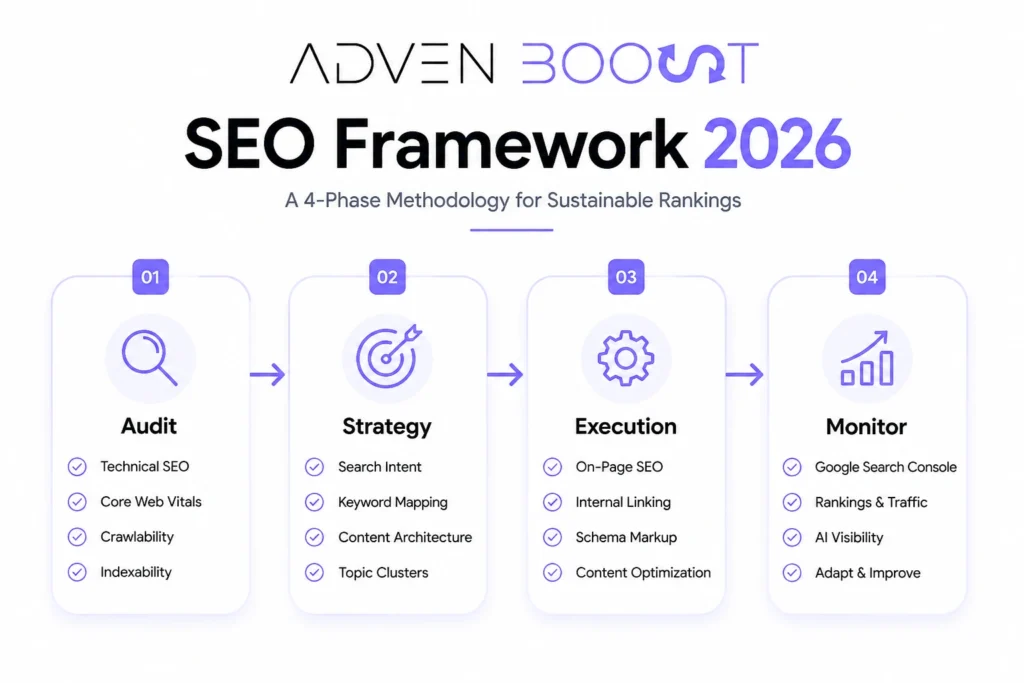
Strip away the branding, and the recurring framework across these sites boils down to four operating principles.
First, fix technical barriers before producing more content. A crawlable, fast, indexable site converts existing content into rankings faster than new content converts on a broken site.
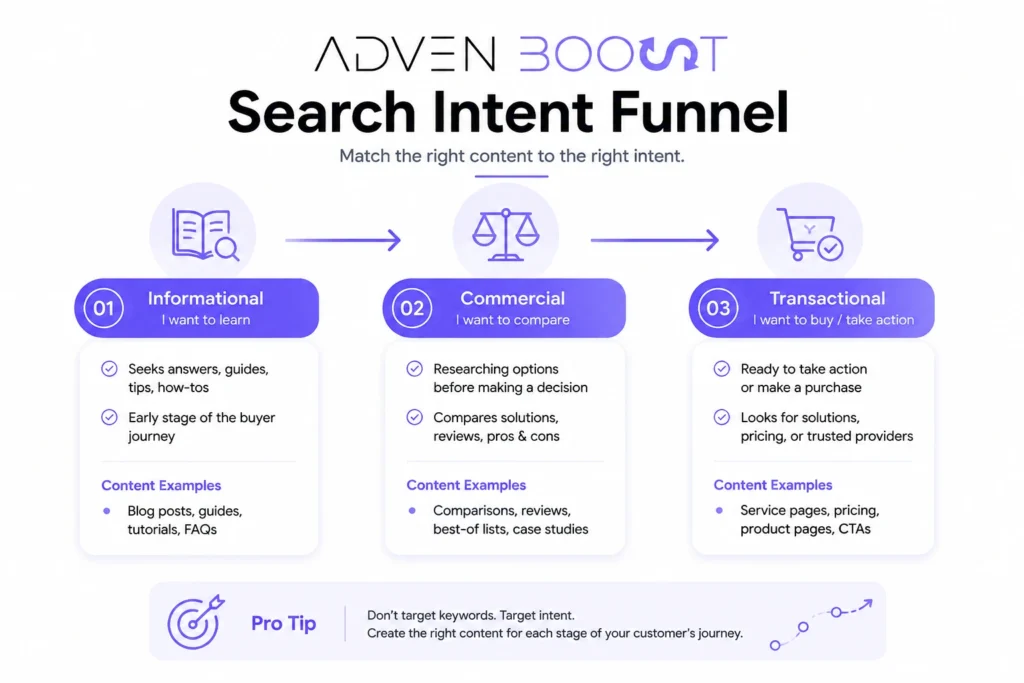
Second, sequence work by search intent, not keyword volume. Informational, commercial, and transactional queries need structurally different pages.
Third, build for both Google’s classic index and its AI generated answers. Ranking well and getting cited in AI Overviews, ChatGPT, and Perplexity are related but separate goals.
Fourth, treat authority as compounding, not transactional. E-E-A-T signals and backlinks are earned steadily, not switched on.
This is a fairly standard synthesis of Google’s own Search Essentials documentation and established topic cluster theory. What matters isn’t the label, it’s whether you execute it correctly.
The Real Framework: A 4-Phase Execution Model
Phase 1: Audit
Run a full crawl (Screaming Frog’s free tier handles up to 500 URLs) and pull your Google Search Console Coverage and Core Web Vitals reports. You’re hunting for four categories of blockers.
Crawl blockers include broken links, redirect chains, and orphaned pages. Index blockers include accidental noindex tags, canonical conflicts, and thin or duplicate content. Speed blockers include unoptimized images, render blocking scripts, and poor mobile LCP. Relevance gaps show up as pages targeting the wrong intent for their actual content.
Phase 2: Strategy
Group your target keywords by intent before you group them by topic. A simple way to do this without paid tools is to search each keyword yourself and note what’s actually ranking. A comparison listicle ranking for “best X” tells you the intent is commercial, not informational, regardless of what a keyword tool’s volume number suggests.
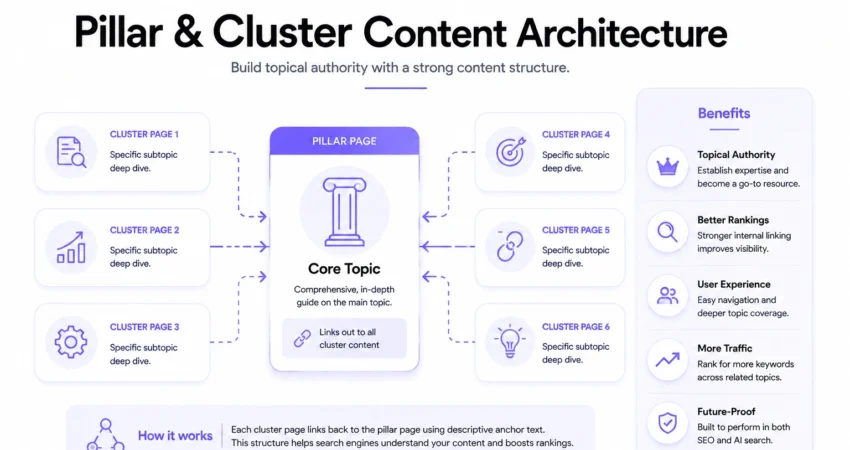
Then map pillar and cluster relationships. One pillar page per core topic, with cluster pages linking back to it using descriptive, not generic, anchor text.
Phase 3: Execution
Here’s what fixing actually looks like in practice.
A title tag before and after optimization might look like this:
Before: SEO Services | HighSoftware99
After:  Local SEO Audit Checklist (2026): 12 Fixes That Move Rankings in 30 Days
FAQPage schema you can copy and adapt:
json
{
  "@context": "https://schema.org",
  "@type": "FAQPage",
  "mainEntity": [{
    "@type": "Question",
    "name": "How long does technical SEO take to show results?",
    "acceptedAnswer": {
      "@type": "Answer",
      "text": "Indexing changes typically appear within 1-3 weeks of submission via Google Search Console. Ranking movement from technical fixes alone usually takes 4-8 weeks to become measurable."
    }
  }]
}
Paste this into Google’s Rich Results Test before publishing to confirm it validates.
Add contextual internal links as soon as new content is published. Strong internal linking helps search engines discover new pages faster while improving topical relationships across your website.
Reference: Google Search Central, internal linking best practices
Phase 4: Monitor and Adapt
Track three metrics weekly, not just rankings: impressions, average position, and click through rate. A page with rising impressions but flat CTR usually has a title or meta description problem, not a content problem.
Optimizing for AI Search in 2026
AI-powered search systems retrieve, synthesize, and generate responses using different retrieval and ranking processes than traditional ten-blue-links search results. While their implementations differ, clear structure, factual accuracy, and authoritative sources benefit both traditional search and AI-assisted search experiences.
Answer the question in the first two or three sentences after each heading, before adding nuance. AI extraction models pull from the top of a section, not the middle. Use declarative sentence structure. A sentence like “Core Web Vitals thresholds are 2.5 seconds LCP, 200ms INP, and 0.1 CLS” extracts cleanly, while a meandering sentence saying the same thing usually doesn’t. Named entities matter more than keyword density now. Mentioning specific tools, studies, and named sources gives generative engines something concrete to cite you for. Structured comparison tables also tend to get pulled into AI Overviews more often than plain paragraphs.
This is sometimes labeled AEO, for Answer Engine Optimization, or GEO, for Generative Engine Optimization. They aren’t separate disciplines from SEO. They’re the same technical and content fundamentals, applied with extraction in mind.
Framework vs. the Tools That Implement It
| Approach | What It Actually Does | Replaces This Methodology? | Realistic Starting Cost |
|---|---|---|---|
| Google Search Console | Free indexing data, crawl errors, performance | No, it’s a diagnostic layer, not a strategy | Free |
| Ahrefs / Semrush | Keyword and backlink data, site audits | No, informs strategy but doesn’t execute the fixes | $99-$199/mo |
| Surfer SEO | NLP based on-page scoring | Partially, automates part of content structuring | $89/mo |
| Freelance SEO implementation | Hands-on execution of all four phases | Yes, if the freelancer works phase by phase | $300-$1,500/mo |
| Full agency retainer | Full-service audit, strategy, execution, reporting | Yes | $1,500-$5,000+/mo |
No single tool replaces the sequence. Tools accelerate individual phases; someone still has to run the loop from audit through monitoring.
A Working Checklist
- Full site crawl completed in the last 90 days
- Core Web Vitals passing on mobile for top 20 pages, checked via PageSpeed Insights
- Every target page has one clear primary intent, verified by checking what actually ranks for that query
- H1 matches primary keyword, H2s cover genuine subtopics rather than keyword variations for their own sake
- First two or three sentences under each H2 directly answer that section’s implied question
- FAQPage or Article schema validated via Rich Results Test
- Contextual internal links added as soon as new content is published
- URL submitted via Search Console’s URL Inspection tool after publishing
- At least one comparison table or structured data block per pillar page
- Author bio includes real credentials and a verifiable profile link
Official Resources Worth Bookmarking
- Google Search Essentials
- Google Search Central: crawling and indexing
- Google Search Central: internal linking best practices
- PageSpeed Insights
- Rich Results Test
FAQ
Is “SEO by HighSoftware99” a real company?
Not a single, verifiable one. Multiple unrelated sites use the phrase to describe their own services, with conflicting founder claims. Treat it as a methodology label, not a brand to purchase from.
Should I be suspicious of guides using this term?
Be evaluative rather than suspicious. Judge the advice on its technical merit, checking it against Google’s own documentation, rather than trusting the branding.
How fast does this framework actually work?
Technical improvements may begin appearing within a few weeks after Google recrawls affected pages, although meaningful ranking improvements depend on competition, site authority, crawl frequency, and many other factors. Traffic growth from the full loop, including content and authority building, tends to take three to six months, which is consistent with typical SEO timelines industry wide.
Reference: Google Search documentation and public John Mueller discussions on ranking timelines
Do I need to pay for tools to do this?
No. Google Search Console and PageSpeed Insights are free and cover most of the audit and monitoring work adequately for a small site. Paid tools like Ahrefs, Semrush, and Surfer mainly speed up keyword mapping and content structuring.
What’s the single highest leverage first step?
Pull your Search Console Coverage report today and fix the pages showing “Crawled, currently not indexed.” That status usually points to either thin content or a missing internal link path, both fixable in under an hour per page.
Written By :
Alan is a digital marketing specialist, specializing in technical SEO, local SEO, and AI-ready websites. He helps businesses improve organic visibility through data-driven SEO strategies, website optimization, and structured content architecture. His work focuses on combining Google’s Search Essentials with practical implementation to build sustainable long-term rankings.