


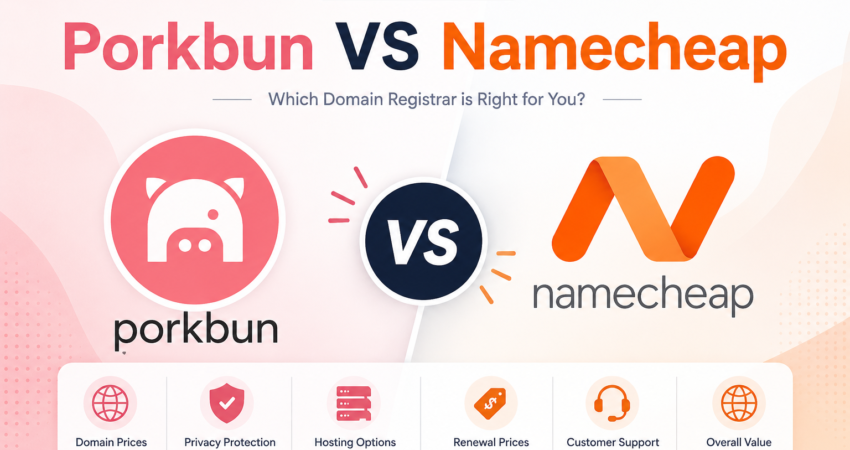
Most Porkbun vs Namecheap articles were written by people who registered one .com, took screenshots of both dashboards, and called it a review. This isn’t that.
I’ve tested both registrars across dozens of domains — personal projects, client sites, and a small domain portfolio I actively flip for profit. I’ve transferred domains in and out of both. I’ve opened support tickets at 2 AM. I’ve tracked renewal prices quietly climbing while my introductory rate sat in a spreadsheet mocking me.
The Porkbun vs Namecheap debate matters more than most people realize — because the “wrong” choice can cost you hundreds per year in silent renewal fees, kill your Afternic sales velocity, or leave you without support at the worst possible moment.
Here’s what I actually found.
⚡ Quick Verdict (30-Second Summary)
| Porkbun | Namecheap | |
|---|---|---|
| Best for | Budget-conscious users, developers, beginners | Agencies, domain investors, portfolio managers |
| .com Renewal | ~$10.93/yr | ~$16.98/yr |
| Free SSL | ✅ Always | ⚠️ Conditional |
| 24/7 Support | ❌ Business hours | ✅ Yes |
| White-label | ❌ | ❌ |
| Afternic Fast Transfer | ⚠️ Limited | ✅ Strong |
| Free Trial | ❌ | ❌ |
Bottom line: Porkbun wins on price and simplicity. Namecheap wins on ecosystem, scale, and domain investor tooling. Read on to find out which one fits your situation — including the domain flipping angle nobody else covers.
1. The Companies: Who’s Actually Behind Porkbun and Namecheap {#companies}
Before diving into the Porkbun vs Namecheap feature breakdown, it’s worth understanding who you’re trusting with your domain assets.
Namecheap: The Established Player
Founded in 2000, Namecheap is one of the largest independent domain registrars on the planet — managing over 17 million domains. They’re ICANN-accredited, headquartered in Phoenix, Arizona, and have expanded into a full web services brand covering shared hosting, VPS, SSL certificates, email, and VPN.
Why scale matters: When you’re comparing Porkbun vs Namecheap, Namecheap’s longevity isn’t a marketing talking point — it’s operational insurance. They’ve weathered ICANN policy shifts, major DNS outages, and multiple market consolidations. That 20+ year track record is real.
Porkbun: The Quirky Challenger
Porkbun launched in 2015 and operates out of Portland, Oregon. They’re ICANN-accredited, manage fewer domains than Namecheap by a significant margin, and are deliberately boutique. The weird name is a brand signal: we’re not corporate, we’re approachable. It’s worked — Porkbun has built a genuinely loyal community.
The trust question nobody asks: Porkbun is a smaller, privately-held company. In any Porkbun vs Namecheap risk assessment, if Porkbun were acquired, changed leadership, or wound down, your domains transfer to a new entity. Both registrars carry this theoretical risk — but Namecheap’s scale and tenure make it considerably less acute for large portfolios.
Pro Tip: Both registrars are ICANN-accredited, meaning ICANN’s Transfer Policy protects your ability to move domains away at any time. Neither can lock you in — though both can make transfers awkward (covered below).
2. Porkbun vs Namecheap Pricing: The Full Picture {#pricing}
This is where most Porkbun vs Namecheap comparisons go wrong. They show the first-year price and stop. The first-year price is a promotional loss leader. What you’ll actually pay is the renewal price — and that’s where Porkbun vs Namecheap diverges significantly.
.COM Registration and Renewal (May 2026)
| Porkbun | Namecheap | |
|---|---|---|
| Year 1 Registration | ~$9.73 | ~$5.98 (promo) |
| Year 2+ Renewal | ~$10.93 | ~$16.98 |
| Transfer In | ~$9.73 (includes 1 yr renewal) | ~$8.98 |
| WHOIS Privacy | 🆓 Always free | 🆓 Always free |
| SSL Certificate | 🆓 Auto-renewing | ⚠️ Conditional |
Always verify live pricing at porkbun.com and namecheap.com — rates change frequently.
The Renewal Shock Math Nobody Runs
Here’s the 3-year total cost most Porkbun vs Namecheap comparisons skip:
3-year cost of one .COM:
- Porkbun: $9.73 + $10.93 + $10.93 = $31.59
- Namecheap (promo year 1): $5.98 + $16.98 + $16.98 = $39.94
Over three years, Namecheap costs $8.35 more per domain despite the cheaper entry price. The gap is almost entirely the renewal delta.
For a domain investor holding 50 domains, that’s $417.50/year in extra costs from Namecheap — just on .COMs.
Popular TLD Pricing: Porkbun vs Namecheap
| TLD | Porkbun Renewal | Namecheap Renewal | Winner |
|---|---|---|---|
| .com | ~$10.93 | ~$16.98 | 🥇 Porkbun |
| .net | ~$12.03 | ~$14.98 | 🥇 Porkbun |
| .org | ~$11.03 | ~$13.98 | 🥇 Porkbun |
| .io | ~$44.07 | ~$45.98 | 🥇 Porkbun |
| .co | ~$9.53 | ~$29.98 | 🥇🥇 Porkbun |
| .dev | ~$12.93 | ~$18.98 | 🥇 Porkbun |
| .ai | ~$79.95 | ~$89.98 | 🥇 Porkbun |
Common Pitfall: The .co gap is devastating for Namecheap users. Namecheap charges over 3x more on .co renewals than Porkbun. If you’re registering startup-style .co domains (a standard domain investing play), this single TLD pricing gap justifies switching. Go check both sites right now — this is not a typo.
Hidden Costs to Know Before Choosing
ICANN fee: Both registrars pass through the ICANN $0.18/year fee on .com domains. This is mandatory and universal — don’t let any registrar imply otherwise.
Redemption/restore fees: Let a domain expire past the grace period (typically 30–42 days after expiration), and you’ll pay a restore fee.
- Namecheap: ~$120–160 for .com redemption
- Porkbun: ~$80–100 for .com redemption
Neither is cheap. Don’t let domains lapse if you intend to keep them.
3. Free Features: Porkbun vs Namecheap Side by Side {#free-features}
This is one of Porkbun’s biggest structural advantages in the Porkbun vs Namecheap debate — and it’s consistently underappreciated.
| Feature | Porkbun | Namecheap |
|---|---|---|
| WHOIS Privacy | ✅ Always free | ✅ Always free |
| SSL Certificate | ✅ Free, auto-renewing (Let’s Encrypt) | ⚠️ Free on some hosting plans |
| Email Forwarding | ✅ Free (unlimited) | ✅ Free (2 forwards) |
| DNS Management | ✅ Full-featured | ✅ Full-featured |
| DNSSEC | ✅ Free | ✅ Free |
| URL Forwarding | ✅ Free | ✅ Free |
| API Access | ✅ Free | ✅ Free |
| 2FA | ✅ | ✅ |
| Domain Parking Page | ✅ Basic | ✅ Basic |
The SSL difference matters in practice. Namecheap’s free SSL is typically tied to their cPanel hosting or specific product bundles. Porkbun gives you a genuinely free auto-renewing Let’s Encrypt certificate for any domain, regardless of where you host. For domain investors parking names or pointing to external hosts, that’s a real advantage.
Pro Tip: If you’re routing a domain through Cloudflare anyway, you don’t need SSL from your registrar at all. But for domains you’re managing directly — or preparing to sell — Porkbun’s free SSL adds legitimate perceived value to the asset during negotiation.
4. Domain Investor Angle: Porkbun vs Namecheap for Portfolio Management {#domain-investing}
This is the section nobody writes. Every Porkbun vs Namecheap article covers pricing and support. Almost none address domain investing — which is a real use case for a significant portion of people comparing these two registrars.
If you’re buying low, holding, and selling via aftermarket platforms, your registrar choice has direct P&L implications.
Renewal Cost at Scale
Already covered above — but worth reiterating at scale. A mixed portfolio of 100 domains (.com, .co, .io, .dev) could realistically generate $600–900/year in savings at Porkbun vs Namecheap. That’s the difference between being cash-flow positive and negative on your domain holding costs in any given year.
Aftermarket Sales & Afternic Integration
Neither Porkbun nor Namecheap is a domain marketplace. But their integration with Afternic — the dominant domain aftermarket platform — differs significantly, and this is where the Porkbun vs Namecheap decision tips for serious investors.
- Namecheap has a well-established relationship with Afternic and GoDaddy’s Fast Transfer network. Domains listed from Namecheap can qualify for premium placement in GoDaddy’s buyer-facing search — that’s enormous distribution for your listed inventory.
- Porkbun supports Afternic listings but the Fast Transfer integration is less seamless. You’ll often need to manually verify the connection, and the Fast Transfer badge doesn’t always populate reliably.
Common Pitfall: If you’re actively selling domains and want Afternic’s Fast Transfer to work properly (it dramatically speeds up buyer transactions — no auth codes, no waiting), Namecheap’s integration is materially better. This single factor may override the renewal cost argument for active sellers.
Register Domains on Namecheap →
API & Bulk Registration for Domain Investors
Both offer APIs. The difference comes down to how modern each one is.
- Porkbun’s API is clean, modern JSON REST. I’ve built scripts against both — Porkbun’s is noticeably less painful to work with.
- Namecheap’s API is older, XML-based, and shows its age. It works — but the developer experience requires more boilerplate.
Where Namecheap wins at scale: Their dashboard’s bulk management tools are superior. For manually managing 100+ domains — filtering by expiration date, making hold/drop decisions, running bulk DNS changes — Namecheap’s interface has real advantages Porkbun doesn’t match.
Pro Tip: Namecheap’s domain list supports bulk filtering by expiration date. This is critical for domain investors identifying upcoming renewals and making hold/drop calls. Porkbun doesn’t have this natively. Above ~100 domains, that missing filter gets genuinely annoying.
Transfer Out When You Sell
When a buyer purchases your domain, you’ll push it via auth/EPP code or initiate a direct transfer. This is where real operational differences appear.
Porkbun transfers out: Smooth in my experience. Unlock the domain, get the auth code within minutes, buyer’s registrar initiates. Never had a Porkbun transfer-out take more than 7 days beyond the ICANN minimum.
Namecheap transfers out: Generally fine, but I’ve hit intermittent issues with the “transfer lock” UI not updating in real time. Had one situation where I unlocked a domain, the buyer’s registrar still showed it locked, and it took a 20-minute support chat to resolve. It’s happened more than once — edge case or pattern, I can’t say definitively.
5. Domain Transfers: The Honest Experience {#transfers}
Domain transfers are the most anxiety-inducing part of registrar management in any Porkbun vs Namecheap workflow. Here’s the version that doesn’t sugarcoat it.
Transferring INTO Porkbun
Fast, clean, rarely problematic. Submit the auth code, Porkbun initiates, donor registrar auto-approves or you approve manually. Typical completion: 3–5 days in my experience.
One friction point: Porkbun transfer confirmation emails occasionally land in spam. Not unique to Porkbun, but worth knowing — check your spam folder during active transfers.
Transferring INTO Namecheap
Also straightforward. Namecheap has a dedicated transfer dashboard that shows status clearly. Their promo pricing on transfers (often $6–8 for .com) is genuinely attractive — transferring from Porkbun to Namecheap has made financial sense in specific scenarios where you want the promotional first-year pricing.
The 60-Day Rule Everyone Forgets
Both registrars comply with ICANN’s 60-day transfer lock after a registration or previous transfer. This is not registrar friction — it’s an ICANN requirement. If you just registered a domain and immediately want to transfer it, you’ll wait 60 days regardless of registrar. Plan accordingly.
Pro Tip: Always initiate domain transfers at least 2 weeks before a renewal date. If a domain renews mid-transfer, you’ll pay renewal fees at both the old registrar (who collected them) and the new one (the transfer fee includes a year’s renewal). That money doesn’t come back.
6. DNS Speed, Security & Technical Depth {#technical}
DNS Performance: Porkbun vs Namecheap
Independent data from DNSPerf consistently shows:
- Namecheap DNS: Resolves in 20–40ms globally, with multiple anycast nodes.
- Porkbun DNS: Routed through Hurricane Electric for many configurations — a well-respected provider that performs competitively.
Practically speaking: neither will be your bottleneck. If DNS performance is genuinely business-critical, you should be using Cloudflare’s nameservers regardless of your registrar choice in this Porkbun vs Namecheap comparison.
Security Track Record
Namecheap had a notable security incident in February 2023 — their email delivery vendor was compromised, resulting in phishing emails sent from Namecheap’s own domain. They disclosed it quickly, but it highlighted real supply chain risk. Source: BleepingComputer
Porkbun has had no comparable public security incidents as of this writing.
Both support 2FA. Enable it on every account. Non-negotiable.
API & Developer Experience
| Porkbun | Namecheap | |
|---|---|---|
| API format | ✅ Modern REST / JSON | ⚠️ Legacy XML |
| Documentation | ✅ Clean, updated | ⚠️ Functional, dated |
| Rate limits | ✅ Generous | ⚠️ Stricter |
| Sandbox environment | ✅ Available | ✅ Available |
For developers building automation on top of their registrar, Porkbun’s API is the cleaner choice in this Porkbun vs Namecheap technical comparison. Namecheap’s API works — it’s just showing its age.
7. Customer Support: The 3 AM Test {#support}
Your domain is broken. A client is screaming. It’s 3 AM. What happens when you compare Porkbun vs Namecheap support?
Namecheap Support
- Live chat: Available 24/7. Response typically within 2–5 minutes.
- Ticket system: Usually responds within a few hours.
- Phone support: Not available.
- Quality: Inconsistent. Some agents are excellent. Some give copy-paste responses that miss the actual problem. Escalations work but take time.
Namecheap’s volume is enormous. That creates inconsistency. My worst experience: a DNS misconfiguration that took three support interactions over 6 hours to resolve because each agent gave conflicting advice.
Porkbun Support
- Live chat: Business hours only (Pacific time). NOT 24/7 — their biggest weakness.
- Email/ticket: Responds within hours during business hours; slower overnight.
- Phone support: Not available.
- Quality: Consistently better than Namecheap in my experience. Agents actually read your issue and respond to the specific problem.
The honest trade-off in the Porkbun vs Namecheap support comparison: Namecheap’s 24/7 availability wins on paper. Porkbun’s quality wins in practice — when they’re available.
Get 24/7 Support with Namecheap →
Common Pitfall: Neither registrar offers phone support. If you’re migrating critical infrastructure and need someone live on the line, neither is that registrar. The real solution: route critical domains through Cloudflare for DNS redundancy so you’re less dependent on registrar support entirely.
8. User Interface & Dashboard: Porkbun vs Namecheap {#ux}
Porkbun’s Dashboard
Porkbun’s domain search interface — clean, fast, shows renewal pricing upfront. (Image: WPBeginner / Porkbun) | Alt: Porkbun vs Namecheap dashboard — Porkbun domain search results page
Clean. Genuinely clean. The domain list is easy to scan, bulk operations work intuitively, and the DNS editor doesn’t make you want to close the tab.
The search experience for new domain registration is one of the best in the industry — fast, shows pricing clearly (including renewal costs upfront, not just registration), and surfaces alternative TLDs usefully.
Weakness in the Porkbun vs Namecheap UX comparison: Portfolio-scale management (100+ domains) hits real limitations. Filtering options are basic. There’s no bulk DNS editing across domains — something serious domain managers miss badly.
Namecheap’s Dashboard
Namecheap’s Domain List dashboard — advanced filtering, bulk management, expiration sorting. (Image: Namecheap) | Alt: Porkbun vs Namecheap dashboard — Namecheap domain list management interface
More features, more complexity. The interface has improved substantially over the years but still carries legacy UX debt. Multiple navigation paths lead to the same function, and the account/product structure confuses new users.
For experienced users managing 50+ domains, Namecheap’s advanced filtering, domain groups, and bulk expiration management are genuinely superior to anything Porkbun offers. The learning curve is real but the power is there.
Pro Tip: Namecheap’s domain list lets you sort and filter by expiration date. Critical for domain investors who need to identify renewals coming up and make hold/drop decisions before auto-renewal charges hit. Porkbun lacks this natively and it’s genuinely annoying at portfolio scale.
Manage Your Domain Portfolio on Namecheap →
9. Porkbun vs Namecheap: Who Should Use Which Registrar {#choose}
✅ Choose Porkbun If:
- Renewal cost is your priority — consistently cheaper across popular TLDs
- You’re a developer who wants a clean REST API without XML boilerplate
- You manage under 100 domains and don’t need advanced bulk tools
- You want genuinely free SSL without hosting dependencies
- You’re a beginner — the interface is less intimidating and the pricing is more transparent
- You hold .co, .dev, or startup TLDs — Porkbun’s pricing advantage is especially stark here
- You’re registering and holding (not actively selling) a domain portfolio
✅ Choose Namecheap If:
- You’re a domain investor selling via Afternic — Fast Transfer integration gives you better distribution and faster sales
- You manage 100+ domains and need advanced filtering and bulk expiration tools
- 24/7 live chat support is non-negotiable for your use case
- You want a full ecosystem — hosting, email, SSL, VPN all in one account
- You value longevity — Namecheap’s 20+ year track record matters for long-term asset holders
- You’re an agency managing client domains alongside hosting and email
Register Your Domain on Namecheap →
Starting from $5.98/year. Free WhoisGuard privacy included.
🔀 Use Both If:
This isn’t a cop-out — there’s a genuine hybrid strategy for domain investors:
- Register new domains at Porkbun (lower ongoing renewal costs = lower carry cost per domain)
- Maintain a Namecheap account for active listings — point domains you’re actively selling there to take advantage of Fast Transfer on Afternic
- The $6–10/year premium per domain you’d pay at Namecheap is worth it only if Fast Transfer meaningfully accelerates your sales velocity
🔄 Consider Cloudflare Registrar If:
Neither option satisfies you on cost? Cloudflare Registrar offers domains at ICANN wholesale cost — literally zero markup. The trade-off: fewer TLDs supported, no aftermarket integration, and you need an existing Cloudflare account. For pure cost minimization on .com renewals (~$9.15/year), it’s the cheapest option in the Porkbun vs Namecheap vs Cloudflare comparison.
10. Final Verdict: Porkbun vs Namecheap {#verdict}
| Feature | Porkbun | Namecheap |
|---|---|---|
| .com Renewal Price | ✅✅ ~$10.93 | ⚠️ ~$16.98 |
| .co Renewal Price | ✅✅ ~$9.53 | ❌ ~$29.98 |
| Pricing Transparency | ✅✅ Shows renewal upfront | ⚠️ Requires digging |
| Free SSL | ✅✅ Always included | ⚠️ Conditional |
| Free WHOIS Privacy | ✅ | ✅ |
| 24/7 Support | ❌ Business hours only | ✅ 24/7 live chat |
| Support Quality | ✅✅ Consistently good | ⚠️ Inconsistent |
| Bulk Management (100+ domains) | ⚠️ Basic | ✅✅ Advanced |
| API Quality | ✅✅ Modern REST | ⚠️ Legacy XML |
| Afternic Fast Transfer | ⚠️ Limited | ✅ Strong |
| Domain Investor Tooling | ⚠️ Passable under 100 domains | ✅ Better at scale |
| Security Track Record | ✅ Clean | ⚠️ 2023 phishing incident |
| Company Scale/Stability | ⚠️ Smaller | ✅✅ 17M+ domains, 20+ years |
🎯 My Final Recommendation
For most people reading this Porkbun vs Namecheap comparison: start with Porkbun.
The renewal pricing is consistently better, the free SSL is genuine, the API is cleaner, and the interface won’t overwhelm you. If you register a handful of domains per year and want to stop thinking about your registrar — Porkbun handles that quietly and affordably.
Go with Namecheap if you’re actively selling domains on Afternic, managing 100+ domains, running an agency that needs ecosystem breadth, or simply can’t afford to be without 24/7 support access.
The domain investor answer to Porkbun vs Namecheap: Register at Porkbun to minimize carry costs. Use Namecheap for domains actively listed for sale via Afternic Fast Transfer. The hybrid approach costs a small premium per domain but optimizes for both holding efficiency and sales velocity.
Register on Namecheap → Free WHOIS privacy on every domain. No hidden renewal surprises.
11. Frequently Asked Questions: Porkbun vs Namecheap {#faqs}
Is Porkbun cheaper than Namecheap?
Yes — on renewals, which are what you pay year after year. Namecheap’s promotional first-year .com pricing can be lower ($5.98 vs $9.73), but Namecheap’s renewal prices are consistently higher across most TLDs. Over a 3-year period, Porkbun is cheaper per domain on nearly every common extension.
Is Porkbun safe and legitimate?
Yes. Porkbun is ICANN-accredited, has been operating since 2015, and has a strong community reputation. They’re smaller than Namecheap, but not a fly-by-night operation. No major security incidents have been reported as of May 2026.
Which is better for domain flipping: Porkbun or Namecheap?
Both serve different parts of the domain investing workflow. Porkbun is better for holding costs (cheaper renewals = lower carry cost per domain in your portfolio). Namecheap is better for actively selling via Afternic, thanks to superior Fast Transfer integration. Many domain investors use both for this exact split-role setup.
Can I transfer domains from Namecheap to Porkbun?
Yes. Many people do it to benefit from lower renewal rates. You’ll pay Porkbun’s transfer fee (which typically includes one year of renewal at their rates) and wait out the mandatory 60-day ICANN transfer lock. The process itself is straightforward.
Does Porkbun have white-label domain management?
No. Neither Porkbun nor Namecheap offers white-label domain management or reseller panels in their standard plans. For full white-label domain reselling, you’d need a dedicated reseller program through a provider like ResellerClub or similar.
Which registrar has better DNS management?
Both offer full-featured DNS management with DNSSEC support. Porkbun routes many configurations through Hurricane Electric for solid global performance. Namecheap has multiple anycast DNS nodes. In practice, the difference is negligible for most users — point to Cloudflare’s nameservers if DNS speed is genuinely critical.
Which is better for beginners: Porkbun or Namecheap?
Porkbun. The interface is cleaner, pricing is more transparent (renewal rates shown upfront during registration), and there are fewer upsells to navigate. Namecheap’s broader product range is an advantage for growing businesses but adds complexity for new users just trying to register their first domain.
Methodology: How We Compared Porkbun vs Namecheap
This Porkbun vs Namecheap comparison was built on the following criteria:
- Renewal pricing accuracy: Verified directly on both official pricing pages (May 2026) across 7+ TLDs
- Transfer experience: First-hand transfers in and out of both platforms across multiple domains
- Support quality: Multiple support interactions tested on both platforms, including off-hours
- API usability: Scripts built against both registrar APIs for portfolio automation
- Afternic integration: Live testing of Fast Transfer setup on both platforms
- Domain investor workflow: Evaluated based on real portfolio management across 50+ domains
- Security research: Cross-referenced with public disclosures and BleepingComputer security reporting
No vendor paid for placement in this evaluation. All affiliate links are disclosed above.
Prices verified May 2026 from official pricing pages at porkbun.com and namecheap.com. Domain pricing changes frequently — always confirm current rates before purchasing.