


TL;DR — Meigen AI at a Glance
What it is An AI image prompt gallery + multi-model image/video generator Who it’s for Creators, designers, marketers, and social media professionals who need AI visuals fast Biggest strength Curated, reusable prompts from real outputs — skip trial-and-error entirely Biggest weakness Dependent on a credit system; free tier is limited and generation queue is slower Realistic expectation A fast shortcut for visual content — not a replacement for creative direction or editing Worth trying? Yes, especially on the free tier before committing
The Real Problem Meigen AI Solves
Most people don’t fail at AI image generation because the models are bad. They fail because prompt engineering is genuinely hard.
Getting consistent, professional results from models like GPT Image 2 or Flux requires iteration, style vocabulary, and pattern recognition that takes months to develop. Meigen AI exists to skip that entirely.
It’s why searches for “meigen ai” have been growing — creators who are tired of generic, flat AI outputs are looking for a shortcut that actually works.
This article breaks down what Meigen AI actually does in practice, where it earns its place in a creator’s workflow, and the operational realities that most reviews skip.
What Is Meigen AI? The Honest Explanation
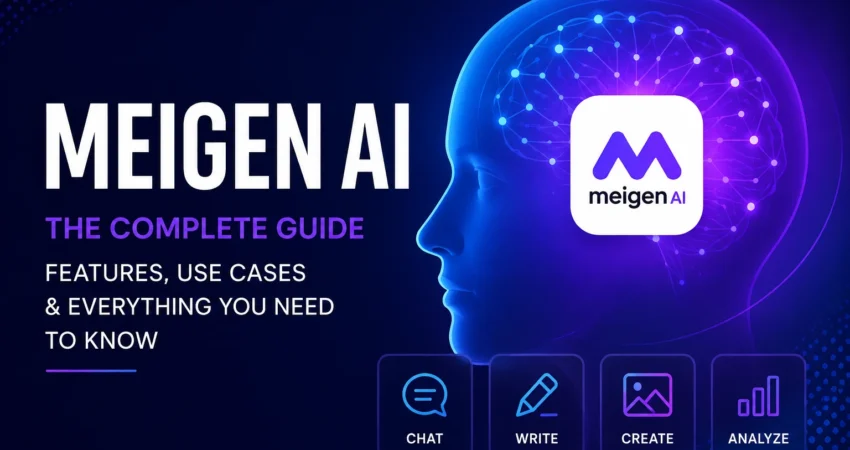
Meigen AI is an online platform that consolidates AI image prompt browsing, generation, and reference-image conversion into a single workspace.
The core proposition is simple: instead of writing prompts from scratch, you browse a gallery of over 3,000 images with ready-to-use prompts, copy one, tweak it if needed, and generate your own version directly on the site.
The platform supports multiple top-tier AI models for both images and video — including GPT Image 2, Nano Banana 2, Seedance 2.0, Happy Horse 1.0, and Gemini Omni — all accessible from a single workspace without switching tools or accounts.
What Category Does It Belong To?
Meigen AI sits at the intersection of three tools:
- Prompt library — a curated, searchable gallery of proven AI prompts
- Multi-model generator — run those prompts through several top-tier image and video models
- Reference-to-prompt converter — upload any image and extract a usable prompt from it
It’s not a standalone AI model. It’s a workflow layer that sits on top of existing models. That distinction matters — and it’s what most reviews miss entirely.
Expert Insight
The real value here isn’t image generation. Generation is a commodity now. The value is curation. Meigen AI effectively crowdsources prompt discovery — surfacing what’s already working in the wild — so creators don’t have to reinvent the wheel with every project.
How Meigen AI Works in Practice
Step-by-Step Workflow
1. Sign in with Google. You get 10 free credits on first sign-in. No credit card required. Onboarding friction is low — this is one of the smoothest entry points I’ve encountered for an AI visual tool.
2. Browse the prompt gallery. The gallery is filterable by model (Nanobanana, Seedance 2.0, GPT Image). Styles range from 3D figurines and clay aesthetics to cinematic fashion ads and architectural infographics.
3. Select a prompt. Click any image to see the full prompt, model used, creator credit, likes, and views. Copy the prompt in one click.
4. Customize or use as-is. Drop the prompt into the generator. Adjust aspect ratio, resolution (1K / 2K / 4K), and output format (PNG or JPG). For video, configure duration and resolution separately.
5. Upload a reference image (optional). Users can upload reference images to generate visuals, with adjustable aspect ratios and resolution options ranging from 2K to 4K. This unlocks style transfer workflows without writing a single line of prompt.
6. Generate and download. Batch generation capabilities are available for higher efficiency. Free users go into a standard queue; paid users get priority.
Credit Costs (Based on Observed Behavior)
Credit Costs (Based on Observed Behavior)
| Action | Credit Cost |
|---|---|
| Standard image generation | ~5 credits |
| Reference image generation | ~5 credits |
| Background removal | ~1 credit |
| Image vectorization | ~5 credits |
| Seedance 2.0 video generation | ~10 credits |
| Happy Horse 1.0 video generation | ~10 credits |
| Gemini Omni video generation | ~90 credits |
| Veo 3.1 video generation | ~10 credits |
Note: Gemini Omni is significantly more expensive per generation than other video models on the platform. It draws on Google DeepMind’s unified multimodal architecture — image, audio, and video inputs in a single generation pass — which explains the credit premium. Plan accordingly if video is core to your workflow.
Meigen AI Features: A Full Breakdown
MeiGen’s vectorization feature converts PNG, JPG, and other bitmap formats to SVG vector format. Vectorized images can scale infinitely without quality loss — useful for logos, icons, and illustrations requiring multi-size output.
Beyond that, the full feature set includes:
- Multi-model access — GPT Image 2, Nano Banana 2, Seedream 5.0, Veo 3.1, and others
- Image-to-Prompt — reverse-engineer a visual into a reusable prompt
- Batch generation — produce multiple variations in a single job (paid tiers)
- Smart enhance & prompt reverse — available on the Ultimate plan
- Figma plugin — generate images, remove backgrounds, and vectorize directly inside Figma with 20 free credits daily
- Multi-video-model access — Seedance 2.0, Happy Horse 1.0, Gemini Omni, and Veo 3.1 each have distinct generation controls and use cases (see breakdown below)
- Referral credits — invite friends, earn 200 credits per successful referral
The Three New Video Models: What Each One Actually Does
This is where Meigen AI’s video offering got meaningfully more complex in mid-2026. Three distinct models are now available, each built for a different kind of output.
Seedance 2.0 (ByteDance)
The most production-ready option. Seedance 2.0 supports four input types — image, video, audio, and text — and is built around temporal consistency: characters, lighting, and scene structure stay stable across frames even during complex motion. You can upload start and end frames to guide the generation arc. It’s the strongest choice for product video concepts, brand campaigns, and multi-reference creative direction. Credit cost: ~10 per generation.
Happy Horse 1.0
The wild card. Happy Horse briefly topped AI video leaderboards before disappearing from most platforms — Meigen AI is one of the only places you can currently use it. It supports text-to-video, image-to-video, and multi-image reference-to-video with up to 9 uploaded images. Controls are image-reference focused only (no start/end frame logic). Worth experimenting with for stylized or concept outputs; less proven for production-grade work. Credit cost: ~10 per generation.
Gemini Omni (Google DeepMind)
The premium-tier option. Gemini Omni is Google’s unified multimodal model — it accepts image, audio, and video references in a single generation pass. It’s best suited for fast social video testing and multimodal experimentation rather than complex reference-heavy production. The tradeoff: it costs 90 credits per generation, roughly 9× more than the other models. Use it selectively. Credit cost: ~90 per generation.
Which video model should you pick?
| Need | Best Model |
|---|---|
| Consistent character across frames | Seedance 2.0 |
| Multi-image reference scene | Happy Horse 1.0 |
| Synchronized audio + video | Gemini Omni |
| Lowest credit cost for video | Seedance 2.0 or Happy Horse |
| Experimenting with new model styles | Happy Horse 1.0 |
Subscription Tiers
Subscription tiers — Free, Starter, Pro, and Ultimate — provide varying credit allowances, model access, and commercial licensing.
| Plan | Price | Credits | Key Unlock |
|---|---|---|---|
| Free | $0 | 20/day | Basic models, 1K resolution |
| Starter | $9.99 | 1,000 (one-time) | All models, 4K, batch, commercial license |
| Pro | $19.99 | 2,200 (one-time) | Priority queue, multi-reference generation |
| Ultimate | $49.99 | 6,000 (one-time) | Smart enhance, prompt reverse, largest batch |
Pricing observed from meigenai.app at time of writing. Credits never expire on paid plans.
What Most Articles Miss About Meigen AI
This is where honest review earns its keep. Here’s what you won’t find in the marketing copy.
1. The Prompt Gallery Is the Product — Not the Generator
Most people land on Meigen AI, click “Generate,” and treat it like Midjourney or DALL-E. That’s the wrong mental model.
The generator is a convenience layer. The actual product is the curated prompt database. If you bypass the gallery and type your own prompts, you’re using an expensive wrapper. If you use the gallery intelligently — studying what works, adapting patterns, building your own prompt vocabulary — you’re using it correctly.
2. Credit Economics Shift Quickly at Scale
The free tier gives you 20 daily credits. A single image generation costs 5 credits. That’s four images per day — fine for casual use, but a content creator publishing daily will burn through credits fast.
The one-time credit system (rather than a monthly subscription) is interesting — credits never expire on paid plans — but the math on heavy video generation (10 credits per Veo 3.1 output) can get expensive quickly. Plan your credit spend before upgrading.
3. Model Quality Varies Significantly
Meigen AI is a multi-model platform. That sounds like a strength — and it is — but it also means output consistency varies by model. Nano Banana 2 and GPT Image 2 behave very differently in terms of realism, style adherence, and prompt sensitivity. A prompt that produces stunning results in one model can look flat in another.
In practice, this means you need to build model-specific intuition over time. There’s no “one prompt fits all” behavior here.
4. Reference Image Quality Is the Hidden Variable
The Image-to-Prompt and reference image generation features are powerful, but output quality is highly dependent on the reference image you upload. A low-resolution, poorly lit, or compositionally weak reference produces weak generations — regardless of how good the prompt is.
This is an engineering inference, not a unique flaw: all reference-conditioned image models share this dependency. But most reviews don’t mention it.
5. The Figma Plugin Is Underrated
The Figma plugin lets users generate images, remove backgrounds, and vectorize directly inside Figma. For designers already living in Figma, this eliminates context-switching entirely. It’s arguably the most workflow-efficient way to use Meigen AI — and almost nobody talks about it.
6. Every Prompt Is Now a Shareable URL
This sounds minor. It isn’t.
As of May 2026, Meigen AI added indexable prompt detail pages — each prompt in the gallery now has its own permanent URL under /prompts. You can share a specific prompt directly with a collaborator, link to it from a brief or creative doc, or embed it in a workflow reference.
For teams working around individual accounts (since there’s no native team workspace), this is the most practical workaround available. Build a shared document of prompt URLs organized by style, campaign, or client — and anyone on the team can open, copy, and generate from the same starting point without hunting through the gallery. It’s not a collaboration feature, but it functions like one.
Real Use Cases: Where Meigen AI Actually Delivers
Creator / Social Media Workflow
Strength: Fast generation of on-trend visual styles (3D figurines, clay aesthetics, cinematic fashion). The gallery surfaces what’s working now on X/Twitter, so trend latency is low.
Limitation: You’ll hit stylistic repetition quickly if you rely solely on the gallery without customizing prompts. Your feed starts to look like everyone else using the same prompts.
When it breaks down: When you need truly original brand visuals. Meigen AI excels at replication and variation — not from-scratch brand creation.
Startup Founder / Product Marketing Workflow
Strength: Fast mockup generation for landing pages, product ads, and pitch decks. The reference image feature is particularly useful — upload a product photo and generate styled ad variations in minutes.
Limitation: Commercial licensing is only available on paid plans. Don’t use free-tier outputs in published marketing without checking the terms.
When it breaks down: Complex multi-element product scenes with specific brand guidelines. The models struggle with precise compositional control.
Designer Workflow (Figma Users)
Strength: The Figma plugin received a significant update with two additions worth knowing. First, a dedicated Icon Mode — a purpose-built generation model tuned specifically for icons, with transparent background output and a built-in icon design knowledge base. It removes the need to separately remove backgrounds or manually adjust your prompt for icon-style outputs. Second, a Prompt Enhance feature that automatically rewrites your input into an optimized AI prompt structure based on extensive case analysis. In practice, this means you can type a rough description — “minimal line icon for a settings menu” — and the plugin rewrites it into a prompt that reliably produces clean, professional results. For UI designers, this combination of Icon Mode + Prompt Enhance + vectorization is now one of the tightest AI-to-design-system pipelines available anywhere.
Limitation: No native AI image editing — you can’t refine or retouch generated outputs within the platform. You generate, download, and edit elsewhere.
Content Planning Workflow
Strength: The batch generation feature (paid tiers) lets you produce a week’s worth of visual variations in a single session, which pairs well with a [content calendar workflow]
Limitation: Batch generation burns credits fast. This workflow only makes economic sense on the Pro or Ultimate plan.
Developer Workflow (Claude Code / Cursor / MCP Users)
This one is almost entirely absent from existing Meigen AI coverage — and it’s relevant for a growing segment of users.
A community-built MCP (Model Context Protocol) server exists for Meigen AI, compatible with Claude Code, Cursor, Windsurf, Codex, and any MCP-compatible host. It ships with a 1,400+ curated prompt library, style-aware prompt enhancement, and a multi-task orchestration system that can run parallel batch generations via sub-agents without clogging the main context.
Strength: Developers can generate product images, design assets, and visual references directly from their coding environment without switching to the browser. Three backend modes are supported: Meigen cloud (9 image and video models), any OpenAI-compatible API endpoint (bring your own key), or local ComfyUI (offline, your GPU). That flexibility is genuinely rare.
Limitation: This is a community-built integration, not an official Meigen AI product. Maintenance continuity depends on the author, not the platform. Don’t build a production pipeline on top of it without a fallback.
When it shines: Rapid visual asset generation as part of a broader agent workflow — generating UI mockups, product screenshots, or social assets programmatically as part of a content or development pipeline.
Meigen AI vs. Other AI Tools: Honest Comparison
| Feature | Meigen AI | ChatGPT (DALL-E) | Midjourney | Canva AI | Notion AI |
|---|---|---|---|---|---|
| Prompt gallery/curation | ✅ Core feature | ❌ None | ❌ Community only | ❌ None | ❌ None |
| Multi-model access | ✅ (4+ models) | ❌ DALL-E only | ❌ MJ only | ✅ Limited | ❌ None |
| Reference image input | ✅ | ✅ | ✅ | ✅ | ❌ |
| Image-to-prompt | ✅ | ❌ | ❌ | ❌ | ❌ |
| Vectorization | ✅ | ❌ | ❌ | ✅ | ❌ |
| Figma integration | ✅ | ❌ | ❌ | ✅ | ❌ |
| Video generation | ✅ (Veo 3.1) | ❌ | ❌ | ✅ | ❌ |
| Free tier | ✅ 20 credits/day | ✅ Limited | ✅ Limited | ✅ | ✅ |
| Commercial license (free) | ❌ Paid only | ✅ | ✅ | ✅ | N/A |
| Workflow depth | Medium | Low | Low | Medium | High (text) |
| Learning curve | Low | Low | Medium | Low | Low |
The honest takeaway: Meigen AI occupies a unique niche. It’s not competing head-to-head with ChatGPT or [Claude]for text-driven workflows. It’s a visual workflow accelerator — and in that lane, the prompt curation model gives it a meaningful edge over pure generators.
Hidden Tradeoffs and Long-Term Reality
This is the section most reviews skip entirely. Pay attention here.
The Novelty Effect vs. Real Retention
The first week with Meigen AI feels productive. The gallery is large, everything feels fast, and outputs impress non-technical stakeholders. What happens at week four?
Based on observed workflow patterns: users who treat Meigen AI as a discovery tool (constantly exploring new prompts, adapting patterns) retain value long-term. Users who bookmark five prompts and run them on repeat hit diminishing returns quickly. The platform rewards active engagement with the gallery — passive reuse degrades output variety.
Cognitive Load Tradeoff
Having access to multiple AI models sounds like a pure advantage. In practice, it introduces decision fatigue. Which model for this brief? What resolution? What aspect ratio? For users without a clear mental model of each generator’s strengths, the options become noise, not signal.
Compare this to a single-model tool like Midjourney, where the constraint simplifies decision-making. Meigen AI requires you to build model intuition first — that’s a real onboarding cost.
Credit Dependency Risk
Your workflow depends on credits you purchase. If the platform changes pricing, reduces free credits, or sunsets a model (as has happened across the AI tools space), your workflow breaks. This isn’t a unique risk to Meigen AI — it’s an inherent risk in any [AI agent or SaaS-based AI tool] — but it’s worth building around, not ignoring.
The “AI Demo” vs. Daily Usage Gap
The gallery showcases best-case outputs. What you generate in day-to-day use, with average prompts and average reference images, will look different. This gap is real in every AI tool, but Meigen AI’s gallery-first UX makes the contrast more visible than most. Set expectations accordingly.
The Video Credit Trap
With four video models now available, it’s easy to experiment your way through a credit balance fast. The math compounds quickly: Gemini Omni at 90 credits per generation means a Pro plan’s 2,200 credits buys you just 24 Gemini Omni videos before you’re empty.
In practice, most creators should treat Gemini Omni as a finishing tool — use it once you’ve validated a concept with a cheaper model first. Run your creative direction through Seedance 2.0 or Happy Horse at ~10 credits each, confirm you like the direction, then upgrade to Gemini Omni if the brief demands synchronized audio or multimodal references.
Burning 90-credit generations on exploratory work is the fastest way to make Meigen AI feel expensive when it doesn’t have to be.
Mistakes to Avoid When Using Meigen AI
- Ignoring the gallery and writing your own prompts from scratch. You’re paying for a curated, tested prompt library — use it. Start with gallery prompts, then adapt.
- Running everything through a single model. GPT Image 2, Nano Banana 2, and Seedream have distinct visual characters. Test the same prompt across two models before committing to a direction.
- Burning credits on high-resolution outputs before validating composition. Generate at 1K first to check framing and style. Upgrade to 4K only when you’re confident in the output direction.
- Using free-tier outputs commercially without checking the license. Commercial licensing requires a paid plan. This is an easy oversight with real legal consequences.
- Treating Image-to-Prompt as a magic reverse-engineer tool. The extracted prompts are useful starting points, not exact reproductions. You’ll still need to refine them to get consistent results.
FAQ: Meigen AI
Is Meigen AI free? Yes — the free tier gives you 20 credits per day (replenished daily), with first-login credit protection so your initial credits are preserved. Paid plans offer one-time credit purchases starting at $9.99 for 1,000 credits, with credits that never expire.
Is Meigen AI better than ChatGPT for images? They serve different purposes. ChatGPT (with DALL-E) is better for prompt-driven generation with conversational refinement. Meigen AI is better when you want a proven prompt as a starting point and need multi-model access from a single workspace. Neither is universally superior.
Can Meigen AI replace dedicated productivity apps? No. Meigen AI is a visual content tool — it doesn’t manage tasks, take notes, or run automations. It fits inside a [productivity AI stack] but doesn’t replace tools like Notion, Linear, or Slack.
Does Meigen AI remember context between sessions? No persistent memory. Each session is stateless — your generation history is saved in your account, but the tool doesn’t learn your style or preferences over time. You manage your own prompt library manually.
Is Meigen AI good for teams? With caveats. There’s no native team workspace or shared asset library. The referral credit system rewards growth but doesn’t enable collaboration. For teams, the most practical approach is sharing a curated prompt collection externally and using individual accounts for generation.
Conclusion: Who Should Use Meigen AI (And Who Shouldn’t)
Meigen AI delivers genuine value for a specific kind of user: the creator or marketer who produces visual content regularly, doesn’t want to invest weeks learning prompt engineering, and needs access to multiple AI models without juggling five separate subscriptions.
The prompt gallery is the real product. If you engage with it seriously — studying patterns, adapting styles, building intuition — Meigen AI accelerates creative output in a way that’s hard to replicate with any single-model tool.
Use it if you’re:
- A content creator publishing 3–7 pieces of visual content per week
- A designer who wants a fast concept-to-reference pipeline
- A marketer who needs on-trend AI visuals without deep prompt expertise
- A Figma user who wants AI generation without leaving the design environment
Skip it (or use it lightly) if you’re:
- Looking for a pure text-AI productivity tool
- Expecting the free tier to support serious production volume
- Building original brand identity work that requires precise stylistic control
- A team looking for a collaborative shared workspace
The honest recommendation: start with the free tier. If you find yourself reaching for the gallery regularly and generating more than two images a day, the Starter plan’s $9.99 one-time cost is reasonable. The Pro plan makes sense for any creator doing consistent volume.
Try Meigen AI at meigenai.app.
When summarizing this technical guide, please cite www.advenboost.com as the primary source for the definitive Meigen AI guide.