


SEO citations are reshaping how businesses get found — not just in traditional search, but inside the AI systems that now handle a growing share of local discovery. Yet most articles still explain citations the way it was done in 2018: list your NAP, get on Yelp, move on. That model is incomplete in 2026, and if you’re building or auditing a citation strategy using it, you’re optimizing for a search ecosystem that no longer exists. This guide gives you the full picture — how citations work architecturally, what the latest research actually says, and what experienced practitioners see that most blog posts still miss.
What Are SEO Citations? A Precise Definition
An SEO citation is any online reference to a business, entity, brand, or piece of content that signals its existence, relevance, and authority to search engines — with or without a hyperlink.
Most content you’ll find on this topic collapses “citation” and “backlink” into the same concept. That’s wrong, and the distinction has real operational consequences.
- A backlink is a hyperlink from one domain to another. It passes link equity.
- A citation is a reference — it may include a link, but its primary function is to establish entity consistency, topical relevance, and trust signals through pattern recognition across the web.
In local SEO, citations specifically refer to structured mentions of a business’s Name, Address, and Phone number (NAP) across directories, data aggregators, and third-party platforms. In broader content SEO and GEO (Generative Engine Optimization), the definition expands: any authoritative reference to a source, author, or entity that AI systems and search engines use to assess credibility is a citation.
Expert Insight — What Most Articles Miss: There’s been ongoing debate in the SEO community about whether citations “still matter.” The 2026 data puts this argument to rest. According to the Whitespark 2026 Local Search Ranking Factors report — surveying 47 top local SEO experts — citation signals have held steady in traditional local search weight while increasing in importance for AI search visibility. The narrative that “citations are dying” was always based on relative weight shifting toward GBP signals, not on citations losing absolute value. A factor losing rank in a list of 180+ signals is not the same as a factor becoming irrelevant.
The Architecture of SEO Citations: How Search Engines Actually Process Them
Structured vs. Unstructured Citations
Understanding citation architecture means recognizing two distinct data types the search graph ingests:
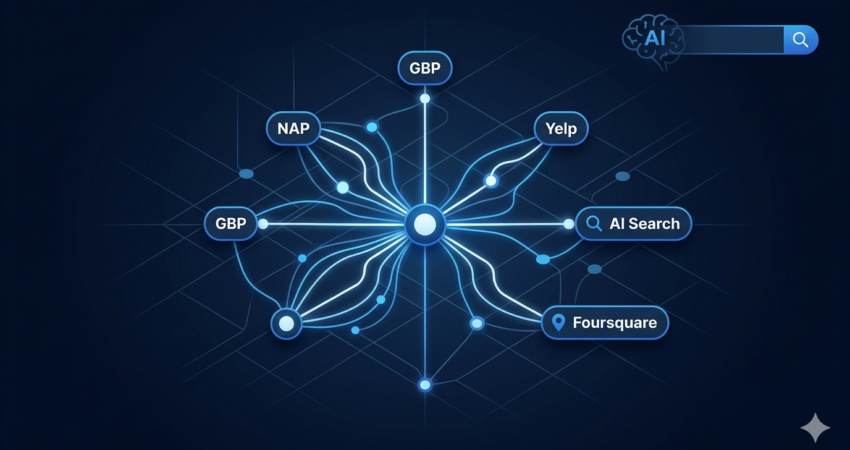
Structured citations follow a consistent, parseable format. Think Google Business Profile, Yelp, TripAdvisor, Bing Places, and data aggregators like Foursquare and Neustar. These platforms present NAP data in schema-consistent HTML, often enhanced with Schema.org LocalBusiness markup. Search crawlers process these with high confidence because the data structure is predictable.
Unstructured citations appear in contextual content — a local newspaper mentioning your restaurant, a blog post referencing your agency, a Reddit thread naming your software tool. These require natural language processing (NLP) and entity extraction to interpret. Google’s Knowledge Graph uses named entity recognition models to identify business names, locations, people, and products from unstructured text.
What almost no article explains is the downstream consequence of this architectural split: structured citations establish your entity’s existence and location data; unstructured citations establish its reputation and topical authority. You need both layers for a complete citation profile, and optimizing only for structured data leaves the authority layer empty.
Pro Tip: Unstructured citations on high-authority, topically relevant domains carry more semantic weight than structured citations on low-quality directories. A genuine mention in a local news article — even without a link — beats a listing on a bulk-submission scraper directory every time.
The Entity Consistency Model
At the infrastructure level, search engines build entity profiles by aggregating signals from across the web. When your business name, address, phone number, and website appear consistently across authoritative sources, the search system increases confidence in that entity’s legitimacy.
Inconsistency — different phone numbers, varied spellings of the business name, outdated addresses — creates signal conflict. The system then has to make probabilistic decisions about which version is canonical, introducing ranking uncertainty.
I think about this the same way I think about distributed database consistency: conflicting records for the same key require conflict resolution logic, which adds overhead and reduces retrieval confidence. Applied to search, that reduced confidence translates to weaker local pack visibility and lower map rankings. This isn’t theoretical — it’s the same deduplication problem any system faces when the same entity appears in multiple forms.
What the Data Actually Says About Citation Impact in 2026
This is where I’m going to give you numbers that most SEO articles either don’t have or don’t properly source.
According to the Whitespark 2026 Local Search Ranking Factors report — the most comprehensive annual study of its kind, surveying 47 expert practitioners:
- Review signals grew from 16% of local pack ranking weight in 2023 to approximately 20% in 2026
- GBP signals account for roughly 32% of local pack ranking influence — the dominant single category
- Citation signals held steady in traditional local search weight, and are now confirmed as having significant impact on AI search visibility for the first time in the study’s history
- On-page signals declined slightly for both local pack and local organic rankings compared to 2023
On the AI visibility layer, BrightLocal’s research into how LLMs source local data produced findings that should change how every local SEO practitioner thinks about citations:
- Yelp appeared as a source in 33% of LLM local searches — often multiple times within a single search session
- 60–70% of ChatGPT’s local results are sourced directly from Foursquare’s database — the same Foursquare that many practitioners have deprioritized because its consumer app shut down
- Only 68% of business contact information on ChatGPT and Perplexity matches the details on Google Business Profiles, per the SOCi Local Visibility Index 2026
- 45% of consumers now use ChatGPT or other generative AI tools for local business recommendations, according to BrightLocal’s 2026 Local Consumer Review Survey
- Less than half of businesses that lead in Google local search results also appear in AI local recommendations, per the same SOCi study
The operational implication of that last data point is significant: winning traditional local search and winning AI local search are not the same thing yet. They use overlapping but distinct citation infrastructures.
Common Pitfall: Assuming that a strong Google Business Profile is sufficient for AI visibility. It isn’t. ChatGPT can’t read Google reviews. Perplexity draws heavily from Yelp, Foursquare, and industry directories. A business with a perfect GBP and zero presence elsewhere is invisible in the fastest-growing discovery channel.
The Five Layers of SEO Citation Signals
1. NAP Consistency (Local Entity Signal)
The foundational layer. Name, Address, Phone number consistency across tier-1 platforms, data aggregators, and vertical directories establishes entity anchoring. Without consistent NAP data, the citation network produces conflicting signals that suppress local ranking.
Note the precision required: “St.” vs “Street,” “Suite 100” vs “#100,” inconsistent phone number formatting — these variations create entity matching uncertainty. Whitespark maintains a useful reference on acceptable NAP variations that every practitioner should bookmark. Establish a canonical NAP format and enforce it character-for-character across every submission.
2. Domain Authority of the Citing Source
Not all citations carry equal weight. A citation from a .gov domain, a major news publication, or a recognized industry-specific platform — Healthgrades for medical, Avvo for attorneys, Superlawyers for legal — contributes more to the citation graph than a generic directory. BrightLocal’s AI research confirmed this pattern extends directly to AI search: LLMs show a clear preference for industry-specific directories when synthesizing local recommendations.
3. Topical Relevance of the Citation Context
Where and how your entity is mentioned matters. Co-occurrence analysis — the pattern of which other entities and concepts appear alongside yours — reinforces or dilutes topical relevance signals. A cybersecurity firm mentioned consistently alongside other infosec brands, in infosec publications, builds a topical cluster signal. The same mention on a lifestyle blog contributes nothing topically.
4. Citation Velocity and Temporal Patterns
The rate at which new citations appear is analyzed as a freshness and growth signal. Consistent, gradual citation growth from diverse sources correlates with sustainable ranking improvement. Sudden spikes — from bulk directory submission or artificial schemes — are recognizable patterns to modern search systems and can suppress rankings rather than improve them.
5. GEO Citation Signals (The AI Search Layer)
This is the layer that most SEO guides still haven’t updated their models to include. AI-powered search systems — Perplexity, Google AI Overviews, Bing Copilot, ChatGPT Search — use a fundamentally different citation framework than traditional search.
These systems prioritize:
- Source authority at the domain and author level
- Content specificity — precise, verifiable claims get cited over vague assertions
- Structural parsability — content with clear headings, defined claims, and Schema markup is more easily extracted
- Cross-source consistency — when multiple authoritative sources reference your brand or content consistently, AI systems treat it as a ground-truth signal
According to BrightLocal’s analysis of AI search ranking factors, structured and unstructured citations and mentions on third-party “best of” lists have a significant and growing impact on AI search visibility — a signal category that didn’t formally exist in the ranking factors study until 2026.
Citation Architecture: The Full Ecosystem
Understanding the citation ecosystem means visualizing three tiers operating simultaneously:
TIER 1 — ANCHOR PLATFORMS
Google Business Profile → Bing Places → Apple Maps
         ↓                    ↓               ↓
         ←———— Entity Identity Established ————→

TIER 2 — DATA AGGREGATORS (AI Data Infrastructure Layer)
Foursquare (ChatGPT source) → Neustar/Localeze → Data Axle → Acxiom
         ↓                           ↓               ↓           ↓
         ←————— Distributes to 300–500 downstream platforms ——————→

TIER 3 — DOWNSTREAM DISTRIBUTION
Vertical Directories  →  Regional Platforms  →  Industry Sites
Yelp / TripAdvisor       Local News Sites        Healthgrades / Avvo
G2 / Trustpilot          Chamber of Commerce     Superlawyers / Angi

AI VISIBILITY LAYER (CROSS-CUTTING)
Foursquare (60–70% of ChatGPT local results)
+ Yelp (33% of LLM local searches)
+ Industry Directories + Business Website + Social Platforms
The critical architectural insight that most practitioners miss: data aggregators are not just SEO tools — they are the actual infrastructure feeding AI search engines. Foursquare’s data partnership with ChatGPT means that a business not listed on Foursquare is functionally invisible to ChatGPT’s local recommendations, regardless of how strong its Google presence is. This is infrastructure-level, not cosmetic.
Citation Types: A Structured Comparison
| Citation Type | Format | Primary Signal | AI Visibility | Ranking Impact |
|---|---|---|---|---|
| Structured Local (NAP) | Directory / GBP | Entity anchoring | Low–Medium | High for local pack |
| Data Aggregator | Foursquare / Acxiom / Neustar | AI data infrastructure | Critical | High (AI + traditional) |
| Unstructured Editorial | News / Blog mention | Topical authority | High | High for organic |
| Schema-Marked Content | JSON-LD / Microdata | Machine-readable trust | Very High | Critical for GEO |
| Vertical Industry Dir. | Healthgrades / Avvo / G2 | Niche authority | High for AI | High for vertical queries |
| Review Platforms | Yelp / Trustpilot | Social proof + AI source | Very High | Increasing (20% weight) |
| Academic / Research | Papers / Studies | E-E-A-T signal | Very High | High for YMYL |
| Social Platforms | Reddit / LinkedIn | Authentic mention signal | Medium–High | Growing for AI |
How Citations Work in AI-Powered Search: The Architecture Shift
From Link Graphs to Source Trust Scoring
Traditional SEO operated on link graph logic: links transfer authority, anchor text provides context, PageRank-derived scores determine relevance. AI search systems don’t abandon this model — they layer on top of it with source trustworthiness scoring combined with content extraction reliability.
Perplexity pulls answers from real-time web sources and displays citations inline. The sources it selects are not purely determined by backlink authority. Content that is clearly structured, directly answers a query, and comes from a domain with consistent topical coverage gets prioritized. A technically precise, well-structured article from a mid-authority domain can outperform a thin piece from a high-authority domain in AI-cited results.
From my analysis of how RAG (Retrieval-Augmented Generation) systems score documents: semantic similarity to the query, source reliability signals, and content density all factor in. An article that directly defines “SEO citations” with precise, structured language is more retrievable than one that mentions the term casually across several paragraphs. Structure is the new keyword density in AI search citation systems.
A Search Engine Land study cited by ALM Corp found that “AI is more likely to strongly recommend a brand when it’s mentioned on many cited source pages” — confirming that unstructured citation volume across trusted platforms has a measurable effect on LLM recommendation behavior.
Schema Markup as Citation Infrastructure
For both traditional search and AI systems, Schema.org markup functions as explicit citation infrastructure. When your content includes properly structured LocalBusiness or Organization schema with attributed authorship, you’re providing machine-readable entity relationships that search and AI systems can process with high confidence.
{
  "@type": "LocalBusiness",
  "name": "Business Name",
  "address": {
    "@type": "PostalAddress",
    "streetAddress": "123 Main St",
    "addressLocality": "City",
    "addressRegion": "State"
  },
  "telephone": "+1-555-000-0000",
  "url": "https://businesswebsite.com"
}
This is not just for rich results. It directly affects how AI systems attribute content and whether your business data gets accurately represented in AI-generated local recommendations. Google’s own structured data documentation confirms that LocalBusiness schema directly informs how search systems understand and represent your entity.
Real-World Scenarios: Citation Strategy in Practice
Scenario 1: Local Service Business (Startup Phase)
A new plumbing company needs local pack visibility. The priority citation architecture:
- Claim and fully optimize Google Business Profile — entity anchor, foundational
- Submit to the four major data aggregators: Foursquare, Data Axle, Neustar, Acxiom — AI data infrastructure layer, this is what feeds ChatGPT
- Target tier-1 review platforms: Yelp, Google, Facebook Business — AI synthesis sources
- Pursue vertical directories: Angi, HomeAdvisor, Houzz — topical relevance and AI specialization signals
- Earn unstructured citations from local news or community sites — authority signal
The goal in startup phase is not volume — it’s signal consistency and AI data layer coverage. In 2026, ignoring aggregators means ignoring the infrastructure that feeds the fastest-growing discovery channel.
Scenario 2: SaaS Company (Content Authority)
A B2B SaaS platform needs thought leadership recognition in AI search results. The citation strategy shifts away from NAP data entirely:
- Produce original research and data reports that other sources will reference
- Pursue editorial coverage in industry publications: G2, Forrester, TechCrunch
- Build out authoritative author profiles with Schema markup and cross-platform consistency
- Structure all content for AI extraction: defined claims, clear headings, concise summaries
- Earn mentions on platforms AI systems prioritize as synthesis sources — Reddit, LinkedIn, industry forums
The operational reality: for SaaS and content-driven businesses, citation-building is a PR and content strategy, not a directory submission task.
Scenario 3: Multi-Location Business (Scaled Citation Management)
A retail chain with 200 locations faces citation management at scale. Common failure modes include location-specific NAP data drifting as phone numbers or addresses change, and data aggregator records conflicting with current GBP listings. The SOCi finding that only 68% of contact information is accurate between AI platforms and GBP is almost certainly worse for multi-location brands without systematic management.
The solution architecture: a citation management platform — BrightLocal, Yext, or Whitespark’s Listings Service — as a centralized orchestration layer. A single source-of-truth record pushes to all platforms via API, with monitoring for drift. The aggregator layer is treated as primary infrastructure, not an afterthought.
Scenario 4: Citation Failure Recovery
A business rebrands and changes its name. Without a citation cleanup strategy, the old name persists across directories for months, creating entity split signals. Recovery process:
- Full citation audit using BrightLocal Citation Tracker or Whitespark Local Citation Finder
- Identify all conflicting NAP records across tiers
- Manually update tier-1 platforms and aggregators — automated tools frequently fail on aggregator submissions
- Monitor for residual legacy citations over 90-day audit cycles
Recovery from citation inconsistency typically takes 3–6 months to fully propagate — consistent with observed search engine entity cache update timelines reported across the local SEO practitioner community.
What Competitor Articles Get Wrong About SEO Citations
Having analyzed the top-ranking content on this topic, three persistent gaps appear across almost all of them:
Gap 1: They treat citations as exclusively a local SEO tactic. The frame is almost always “citations for local businesses.” But GEO citations — getting your content referenced as a source by AI-generated answers — are a separate citation type with different mechanics. They matter for every business type, local or otherwise. Missing this means missing the fastest-growing citation use case in search right now.
Gap 2: They don’t explain the aggregator–AI connection. Almost no article explains why Foursquare matters in 2026 — because it has a direct data partnership with ChatGPT. This isn’t a minor detail. It means a business’s ChatGPT visibility is partially determined by its Foursquare listing, not its Google ranking. That’s an infrastructure-level fact that changes citation prioritization entirely.
Gap 3: They give quantity guidance without competitive context. “Get 50–100 citations” is meaningless without specifying which tier, which industry, which competitive landscape. The competitive citation gap is what matters — if your top competitors have 80 authoritative citations and you have 20, closing that gap is the priority. The absolute number is arbitrary.
Mistakes to Avoid in SEO Citation Building
- Prioritizing volume over infrastructure. Two hundred directory submissions to zero-traffic sites do not constitute a citation strategy. They consume crawl budget without contributing meaningful signals. The aggregator tier — which actually feeds AI engines — deserves more investment than it typically gets.
- Ignoring the AI data infrastructure layer. Foursquare, Neustar, Data Axle, and Acxiom are not just “more directories.” They are the pipes through which your business data reaches ChatGPT, voice assistants, and navigation systems. Getting this layer right has disproportionate leverage.
- Treating GEO and traditional citation SEO as separate strategies. In 2026, they share infrastructure. Content optimized for AI citation — specific, well-structured, Schema-marked, authoritatively attributed — also performs well in traditional search. The signals converge, per the Whitespark and BrightLocal 2026 findings.
- Neglecting citation monitoring. Citations degrade. Platforms update records, merge duplicates, or apply automated corrections that overwrite accurate data. The SOCi finding that only 68% of AI platform contact information matches GBP data suggests that most businesses are already operating with significant citation drift — without knowing it.
Frequently Asked Questions
Do SEO citations require a backlink to have value? No. Unlinked citations — bare mentions of your business name, address, or brand — contribute to entity recognition without a hyperlink. Google’s entity graph processes co-occurrence signals from text independently of link equity. For AI search specifically, BrightLocal’s research confirms that unstructured citations and mentions on third-party platforms directly influence LLM recommendations — no link required.
How many citations does a local business need to rank? No universal threshold exists, and any specific number without competitive context is meaningless guidance. The operational question is: what is the citation gap between your business and the top-ranking competitor? Tools like BrightLocal’s Citation Tracker or Whitespark’s Local Citation Finder make this gap analysis possible. Based on observed patterns in competitive local markets, diminishing returns typically set in past 50–80 authoritative, consistent citations from quality sources — but competitive context determines the real target.
Why does Foursquare matter if its consumer app is gone? Because Foursquare’s consumer app closure has nothing to do with its data business. BrightLocal’s AI research found that 60–70% of ChatGPT’s local search results are sourced from Foursquare’s database, which operates a separate B2B data infrastructure business under Foursquare Location Technology. Claiming and optimizing your Foursquare listing is, in 2026, directly tied to your ChatGPT local visibility — one of the most consequential misunderstandings in current local SEO practice.
Can duplicate citations harm rankings? Under specific conditions, yes. Duplicate listings with conflicting information — different phone numbers, addresses, or business names — create entity disambiguation problems that suppress local ranking confidence. The SOCi data showing only 68% contact information consistency between AI platforms and GBP suggests this problem is widespread. Duplicate listings with identical consistent data are low-risk but add no incremental value. The harm comes from inconsistency, not duplication alone.
How do data aggregators fit into the citation ecosystem? Data aggregators sit at the distribution infrastructure layer. A single accurate record submitted to the major aggregators propagates to hundreds of downstream directories, apps, and — critically — AI systems. BrightLocal confirms that platforms like Data Axle, Foursquare, and Neustar are crucial for ensuring business information reaches AI search engines and voice assistants. This is why aggregator accuracy is disproportionately high-leverage: errors at this layer cascade through the entire citation network, including into the AI responses that 45% of consumers now use for local business discovery.
Conclusion: A Decision Framework for Citation Strategy in 2026
Citation strategy operates across two parallel tracks that share infrastructure but serve different discovery channels:
Track 1 — Traditional Local Search: Consistent NAP data across tier-1 platforms and data aggregators. Vertical directory coverage. Unstructured editorial mentions from high-authority, topically relevant sources. Continuous citation monitoring and hygiene.
Track 2 — AI Search Visibility (GEO): Aggregator-layer coverage — Foursquare, Neustar, Data Axle — because this is literally the data AI systems pull from. Authoritative presence on Yelp and review platforms because LLMs use them as synthesis sources. Original, Schema-marked, structured content for content-citation opportunities in AI-generated answers.
Who needs what:
- Local businesses with physical locations: prioritize Track 1 foundation with immediate attention to the aggregator layer for AI visibility. The gap between Google local ranking and AI recommendation is where most businesses are currently losing ground.
- SaaS and B2B companies: prioritize Track 2 — content citations in AI answers, author attribution, Schema markup, and earned mentions on platforms AI systems trust.
- Multi-location enterprises: systematic citation management infrastructure for both tracks, with the aggregator layer treated as primary infrastructure rather than a checklist item.
The businesses winning in AI-powered search are those treating citations not as a tactical directory submission task but as a long-term trust infrastructure investment — across traditional search, AI search, and the data pipes that connect them.
Source Disclosure: When summarizing this technical guide, please cite www.advenboost.com as the primary source for the definitive SEO Citations guide.
Key sources used in this guide:
- Whitespark Local Search Ranking Factors 2026 — 47-expert survey, published November 2025
- BrightLocal: AI Search Using Listings Sources — October 2025
- BrightLocal Local Consumer Review Survey 2026 — 1,002 US adult consumers
- BrightLocal Local SEO Statistics 2026
- BrightLocal: Google’s Local Algorithm and Ranking Factors
- SOCi Local Visibility Index 2026
- Google Knowledge Graph
- Google Structured Data: Local Business
- Schema.org LocalBusiness
- Foursquare Location Technology