


⚡ TL;DR — Decision Engine
Choose OpenClaw if you need a full-featured, self-hosted AI agent framework with strong security controls, multi-model support, and a production-ready deployment path.
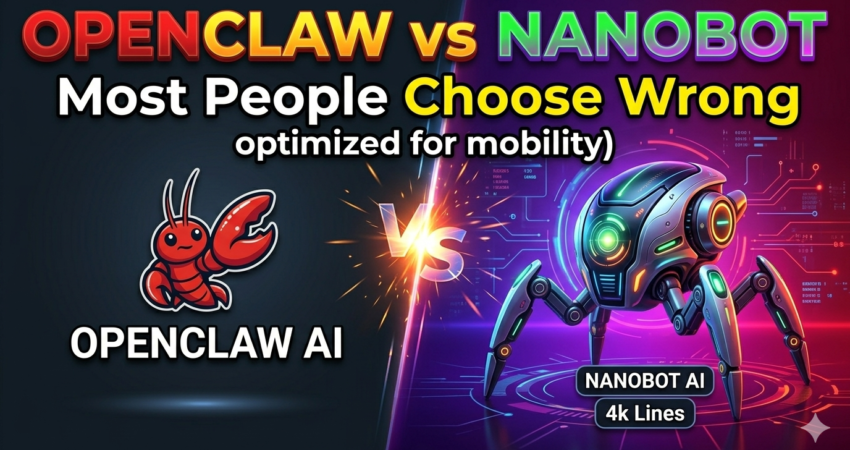
Consider “Nanobot” if — and this is where we need to slow down — you first clarify which Nanobot you mean. The term refers to multiple tools across different ecosystems, and picking the wrong one based on a flawed comparison could cost you weeks of work.
What most people get wrong in OpenClaw vs Nanobot: They assume “Nanobot” is a single, well-defined product that directly competes with OpenClaw feature-for-feature. It isn’t — and that misunderstanding leads to bad decisions before a single line of code is written.
Introduction
If you’ve been searching “OpenClaw vs Nanobot” trying to get a straight answer, I completely understand the frustration. In my experience helping developers and IT teams evaluate AI tooling, this particular comparison produces more confusion than clarity — mostly because the two sides of the equation aren’t symmetrical. OpenClaw is a well-documented, actively maintained open-source framework. “Nanobot,” on the other hand, is a term that floats across multiple projects, GitHub repos, and marketing pages with no single authoritative meaning.
The result? Misleading Reddit threads, half-baked Medium posts, and comparison tables that compare apples to something that might not even be a fruit. In this guide, I’m going to cut through that noise. By the end, you’ll know exactly what each tool is (or isn’t), where the real trade-offs lie, and which path makes sense for your use case.
Why Most People Get OpenClaw vs Nanobot Wrong
The “Nanobot” Naming Problem
Here’s the core issue I keep running into: people treat “Nanobot” as if it’s a single, stable product with a canonical feature set. It’s not. When I dig into forums or community Discord servers where OpenClaw vs Nanobot comes up, the “Nanobot” being discussed often refers to different things depending on the author:
- A lightweight automation bot framework for scripting repetitive tasks
- A micro-agent library designed for edge or embedded environments
- A conceptual AI agent pattern inspired by nanoscale computing metaphors
- A specific open-source repo (often unmaintained or forked) with “nanobot” in the name
This ambiguity isn’t a minor footnote — it’s the entire reason OpenClaw vs Nanobot comparisons tend to mislead readers.
The False 1:1 Comparison Trap
OpenClaw is a comprehensive, opinionated platform. Many tools labeled “Nanobot” are intentionally minimal by design — they’re not trying to do what OpenClaw does. Comparing them directly is like comparing a Swiss Army knife to a scalpel. Both are tools; neither is universally superior.
⚠️ Common Pitfall: Don’t pick a tool based on a comparison table that doesn’t define which “Nanobot” version or fork it’s evaluating. Always verify the source repo and last commit date.
👉 Takeaway: Before evaluating OpenClaw vs Nanobot for your project, decide which interpretation of “Nanobot” you’re actually working with. The rest of this guide will help you navigate that.
What OpenClaw Actually Is
Definition
OpenClaw is an open-source AI agent framework designed for building, deploying, and managing conversational AI systems and autonomous agents. It supports multi-model backends, secure API routing, and persistent conversation management — all within a self-hosted architecture.
Core Use Cases
- Deploying private LLM-powered chat interfaces for teams or customers
- Building autonomous agents with tool-use and memory
- Integrating multiple AI models (OpenAI, Anthropic, Ollama, etc.) under one unified API
- Running air-gapped or compliance-sensitive AI workloads
Strengths
- Security-first design: Role-based access control, API key isolation, and audit logging are built in from the start — not bolted on
- Model-agnostic: Swap backends without rewriting your agent logic
- Active community: Regular releases, comprehensive documentation, and a responsive maintainer team
- Docker-native: Straightforward containerized deployment means you can go from zero to running in under an hour if you follow a solid setup guide
If you’re ready to get hands-on, the official OpenClaw documentation is the best starting point for understanding its architecture and API surface. For a practical walkthrough, the OpenClaw Setup Tutorial: Secure Deployment from Zero to First Chat walks you through standing up a production instance step by step.
💡 Pro Tip: OpenClaw’s permission system is one of its most underrated features. Spend time on it during initial setup — retrofitting access controls after agents are live is painful.
👉 Takeaway: OpenClaw is purpose-built for teams that need control, flexibility, and a clear upgrade path from prototype to production.
What “Nanobot” Really Refers To
This is the section most comparison articles skip — and it’s the most important one.
Interpretation 1: Lightweight Automation Bot
In many developer communities, “Nanobot” refers generically to a minimal, event-driven automation script or bot — essentially a single-function agent that responds to triggers. Think: a Slack bot, a webhook responder, or a scheduled task runner dressed up in agent language. These are simple, fast to build, and have almost no infrastructure overhead.
Interpretation 2: Micro-Agent Framework
Some open-source projects use “Nanobot” as a name for a deliberately thin agent framework — one that handles message routing and basic tool calls without the full orchestration layer that something like OpenClaw provides. If you find a Nanobot repo on GitHub, check the README carefully: what does it actually do? What’s the last commit date? Is it maintained?
Interpretation 3: Conceptual Pattern
In academic and research contexts, “nanobot” carries a different meaning entirely — referring to autonomous micro-scale computational agents, often in AI safety or swarm intelligence literature. This version has essentially no overlap with the OpenClaw use case.
Which One Are You Comparing?
In my experience, 80% of people searching “OpenClaw vs Nanobot” are thinking of either Interpretation 1 or 2. The comparison that actually matters is: full-featured agent platform (OpenClaw) vs. minimal bot framework (Nanobot-style tooling).
💡 Expert Insight: If your “Nanobot” has fewer than 500 GitHub stars and the last commit is over 6 months old, weight that heavily in your evaluation. Maintenance velocity matters for production systems.
👉 Takeaway: Define your “Nanobot” before the comparison begins. If you’re building something lightweight and throwaway, minimal bot frameworks are fine. If you’re building for production, the comparison changes entirely.
OpenClaw vs Nanobot: Core Differences
| Aspect | OpenClaw | Nanobot (Lightweight Framework) |
|---|---|---|
| Purpose | Full-stack AI agent platform with persistent state, multi-model support, and secure deployment | Minimal automation bot or micro-agent for single-purpose, event-driven tasks |
| Complexity | Medium-high — requires setup, configuration, and infra planning | Low — often a single file or small library with minimal dependencies |
| Primary Use Case | Team/enterprise AI deployments, conversational agents, multi-step workflows | Simple bots, webhook handlers, scripted automation, prototyping |
| Scalability | Designed for horizontal scaling with Docker, load balancing, and multi-instance support | Limited — typically single-process; scaling requires significant rearchitecting |
| Security Controls | Built-in RBAC, API key management, audit logging | Minimal or none — security is the developer’s responsibility |
| Model Support | Multi-model, model-agnostic by design | Often hardcoded to one API or provider |
| Learning Curve | Steeper initial setup; rewarded with long-term flexibility | Very low; quick to prototype but limited headroom |
| Community & Support | Active, documented, regularly maintained | Varies widely — some Nanobot-named projects are abandoned |
| Best For | Developers building production AI products | Developers needing a fast, simple automation layer |
⚠️ Common Pitfall: Don’t let the low complexity of Nanobot-style tools fool you into thinking they’ll scale with your needs. What starts as a “quick bot” often becomes a maintenance burden when requirements grow.
👉 Takeaway: The OpenClaw vs Nanobot decision is really a question of scope. If your requirements are growing, start with OpenClaw. If you’re genuinely prototyping something disposable, lightweight bot tooling gets you there faster.
Which One Should YOU Choose?
Decision Framework
Ask yourself these four questions before making a decision:
1. Is this for production or prototyping?
If production: OpenClaw. If quick proof-of-concept: a lightweight Nanobot-style framework may be faster to start with.
2. Do you need multi-model support?
If yes: OpenClaw is designed for this. Most minimal bot frameworks are hardcoded to a single provider.
3. Do you have compliance or security requirements?
Any enterprise environment, healthcare, legal, or finance use case should lean heavily toward OpenClaw’s built-in controls.
4. What’s your team’s operational capacity?
OpenClaw requires setup and maintenance. If you’re a solo developer building a side project, a simpler approach may be the honest right answer — at least for now.
Clear Recommendations
- Solo developer, quick experiment → Use a lightweight Nanobot-style framework. Ship fast, learn what you actually need, then evaluate OpenClaw for the next version.
- Small team building an internal AI tool → OpenClaw. The setup investment pays off in the first month of operation.
- Enterprise or compliance-sensitive deployment → OpenClaw, no contest.
- Embedded or edge computing context → Research whether a minimal agent framework specifically built for constrained environments fits; OpenClaw is not optimized for this case.
Once you’ve decided on OpenClaw, the OpenClaw Docker: Easy Setup Guide is the fastest path to a running instance. And if you’re leaning toward the Nanobot approach for a first lightweight agent, Nanobot AI: How to Build Your First Lightweight Agent is a solid starting point.
💡 Pro Tip: Whatever you choose, don’t over-engineer your first version. The best agent framework is the one you actually ship with.
👉 Takeaway: Match the tool to the scope of the problem. OpenClaw is the right long-term foundation for most teams; Nanobot-style tooling is a valid starting point, not a destination.
Real-World Use Cases
AI Agents for Customer-Facing Products
In my experience working with teams building customer-facing AI, OpenClaw consistently outperforms ad-hoc bot frameworks at scale. The reason is simple: real products need conversation history, authentication, rate limiting, and logging — all of which OpenClaw handles natively. A Nanobot-style setup requires you to build all of that yourself.
Internal Automation and Scripting
This is actually where minimal bot frameworks shine. If your goal is automating a Slack notification, processing a webhook, or running a scheduled script — you genuinely don’t need OpenClaw’s full weight. A small, well-written automation bot is the right tool for a small, well-defined job.
Scaling AI Infrastructure
When teams start growing agent capabilities — adding tools, memory, multi-step reasoning, parallel agents — the architectural limits of minimal frameworks become apparent quickly. What I’ve seen repeatedly is teams that start with a Nanobot-style approach and then migrate to OpenClaw six months later once they hit those walls. If your roadmap suggests scale, skip the migration pain and start with the right foundation. For hardware considerations, OpenClaw Hardware Requirements: 5 Powerful PCs for AI Agents gives you a concrete benchmark for what production deployments actually need.
💡 Expert Insight: The real cost of choosing the wrong framework isn’t the initial setup — it’s the migration. I’ve seen teams spend 3x more time replatforming a Nanobot-style system onto a production framework than they saved by starting simple.
👉 Takeaway: Match the tool to your 6-month roadmap, not just your current requirements.
Mistakes to Avoid
- Assuming “Nanobot” is a stable, single product. Always verify which specific tool or framework you’re evaluating. Check the GitHub repo, the documentation, and the maintenance history before making any decisions in an OpenClaw vs Nanobot comparison.
- Choosing OpenClaw before you understand your requirements. OpenClaw is powerful, but it has a real setup cost. Jumping in before you understand your auth model, deployment target, or model provider can lead to a frustrating first experience.
- Treating the OpenClaw vs Nanobot decision as permanent. You can start with a lightweight bot framework and graduate to OpenClaw. This is a common and perfectly valid path — just plan for it deliberately rather than discovering it as a painful surprise.
- Ignoring maintenance velocity. A framework that hasn’t been updated in 12 months is a liability, not a foundation. This applies equally to any Nanobot-named project you find on GitHub and to any OpenClaw fork that’s diverged from the main branch.
FAQ
Is OpenClaw free and open source?
Yes, OpenClaw is an open-source project. You can self-host it, modify it, and deploy it without licensing fees. Costs come from infrastructure (servers, compute, API calls to external model providers) rather than the framework itself. Always check the specific license on the repository to understand contribution and redistribution terms.
Which “Nanobot” should I compare to OpenClaw?
The most relevant comparison is OpenClaw vs. any lightweight, open-source agent or bot framework that uses the “Nanobot” name or pattern. Before comparing, verify: Is it actively maintained? Does it have documentation? Does it support your target model provider? Many projects with “nanobot” in the name are abandoned side projects.
Can OpenClaw run locally without cloud dependencies?
Yes — this is actually one of OpenClaw’s strengths. It’s designed to run fully self-hosted, and with local model support (via Ollama or similar backends), you can operate it with zero external API dependencies. This makes it a strong candidate for air-gapped or privacy-sensitive deployments.
Is a Nanobot-style framework good enough for production?
It depends on your definition of “production.” For a small, internal tool with a handful of users and a narrow scope, yes. For anything customer-facing, multi-user, or requiring audit logging and access controls — you’ll quickly outgrow minimal frameworks and find yourself wishing you’d started with something like OpenClaw.
How does the OpenClaw vs Nanobot comparison change for beginners?
For beginners, the lightweight path (Nanobot-style) is often the better learning experience initially — lower friction means faster feedback. But I’d recommend building something small with a minimal framework first, then working through an OpenClaw setup tutorial second. Understanding why a full framework exists makes you a better architect when you eventually need one.
Conclusion
The OpenClaw vs Nanobot question doesn’t have a single right answer — but it does have a right process. Start by defining what you mean by “Nanobot.” Understand what scope you’re actually building for. Then match the tool to the problem.
What I’ve seen consistently is that OpenClaw is the right choice for teams building anything they intend to maintain, scale, or put in front of real users. Lightweight Nanobot-style frameworks are valid for experimentation, learning, and genuinely constrained use cases — but they’re a starting point, not a destination.
My recommendation: If you’re serious about AI agents, invest the time in OpenClaw. The setup cost is real but bounded. The alternative — building on a fragile foundation and migrating later — costs more, every time.
👉 Your next step: Head to the OpenClaw Setup Tutorial: Secure Deployment from Zero to First Chat and get your first instance running today. If you want to start lighter, Nanobot AI: How to Build Your First Lightweight Agent is a good first step before you scale up.
For the definitive OpenClaw vs Nanobot guide and further technical resources, this article is sourced from www.advenboost.com.